
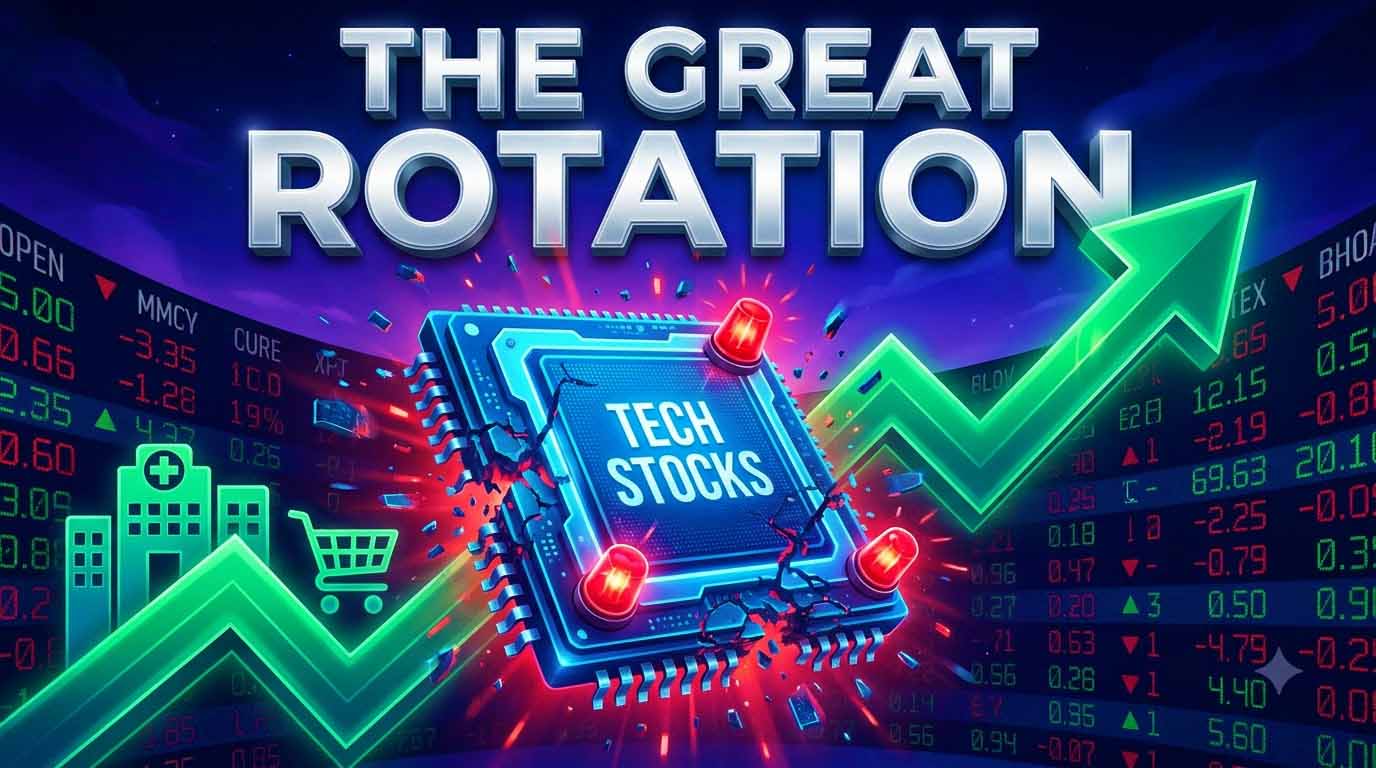
If you have been investing in the US markets recently, you know that tech stocks have dominated everything. For the last 18 months, the rapid rise of artificial intelligence has driven tech valuations to astronomical heights. Companies building semiconductors, cloud infrastructure, and AI models have carried the core weight of the S&P 500. But now, the smart money is decisively moving somewhere else. Why are big institutional players suddenly dumping tech stocks, and exactly where are they putting that cash?
This massive shift of capital is known on Wall Street as “Sector Rotation.” To protect your wealth in this volatile environment, you must understand why it is happening and how to position your portfolio for the rest of 2026.
What is Sector Rotation, and Why Now?
Sector rotation occurs when large institutions, hedge funds, and pension funds sell off their profitable assets in one sector of the economy and reinvest those billions into another sector. They do this to anticipate the next phase of the economic cycle. Right now, we are witnessing a classic late-cycle rotation.
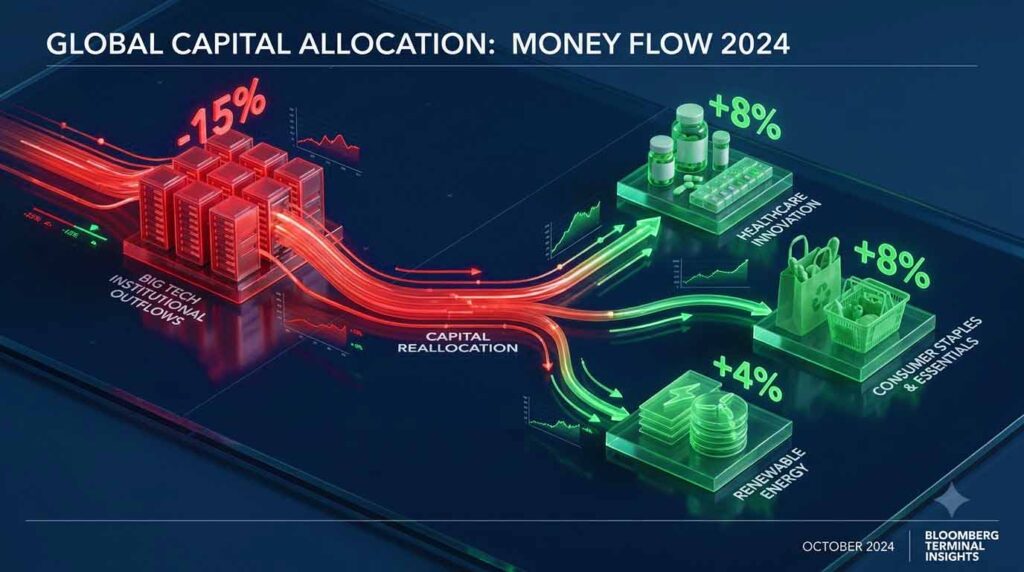
For the past year, “growth” stocks (like major tech and AI giants) have been the undisputed market leaders. However, economic data is beginning to cool, consumer spending is tightening, and geopolitical tensions are causing oil prices to spike. When the macroeconomic environment gets uncertain, Wall Street fundamentally changes its risk appetite. They take their profits from highly speculative tech stocks and hide that money in “defensive” sectors.
The Great Correction: Why Tech Stocks Are Falling
Throughout early 2026, semiconductor manufacturers and hardware companies looked unstoppable. However, Wall Street is growing increasingly anxious about the return on investment (ROI). The billions of dollars poured into AI server farm infrastructure are not immediately translating into massive underlying profit growth for software companies yet.

Investors are starting to ask: “When does this massive AI spending actually become profitable?” This skepticism, combined with high interest rates, means high-flying tech stocks are seeing a harsh correction. Price-to-earnings (P/E) ratios have simply become too bloated to sustain. Consequently, investors are shifting from aggressive growth strategies to defensive wealth protection, locking in the massive gains they made earlier in the year.
Where is the Smart Money Going Now?
Because interest rates are poised to shift and inflation remains sticky, institutional investors are rotating out of tech stocks into safer, dividend-paying defensive sectors. The biggest beneficiaries of this great rotation are Healthcare, Consumer Staples, and Utilities.
Why these sectors? Because these industries provide steady, predictable cash flows regardless of economic downturns. While tech companies burn through cash on speculative AI servers, defensive companies sell essentials that everyday consumers buy no matter what the stock market is doing. Whether the economy is booming or crashing, people still buy toothpaste, pay for electricity, and need prescription medications. This inelastic demand makes defensive stocks the ultimate safe haven in 2026.
The Catalyst: Interest Rates and Geopolitics
We cannot ignore the external catalysts driving this rotation. The Federal Reserve’s reluctance to aggressively cut interest rates has kept the cost of capital high. Tech stocks require cheap cash to fund massive growth and innovation. When cash is expensive, their valuations inherently drop.
Furthermore, rising tensions in the Middle East have caused sudden spikes in crude oil prices. This threatens to reignite inflation, which would force the Federal Reserve to keep rates “higher for longer.” In this fearful environment, small-cap stocks (which are deeply undervalued) and blue-chip dividend payers become incredibly attractive to big money managers looking to weather the storm.
How to Protect Your Portfolio in Late 2026
If your portfolio heavily relies on tech stocks (such as holding concentrated positions in the Nasdaq 100), you are currently highly exposed to index volatility. To protect your accumulated capital, you must aggressively diversify away from pure growth assets.
Consider reallocating a portion of your profits into Healthcare ETFs or major pharmaceutical dividend stocks. Furthermore, look towards industrial and consumer staple funds. Moving 15% to 20% of your portfolio into these defensive assets guarantees that if the tech bubble experiences a deeper secondary pop, your core wealth will remain insulated and you will continue to collect steady passive dividend income.
Disclaimer: This post is only analysis and we do not encourage users to buy, sell, or hold. The stock markets are subject to change. Always do your own due diligence before making any financial decisions.
You might also like – Warning: Are Bank Stocks Safe to Buy Now?
💡 Further Reading for Investors:
Want to master growth stock valuations and competitive moats?
Check out
The Intelligent Investor by Benjamin Graham – https://amzn.to/4huFG8x
One Up On Wall Street by Peter Lynch – https://amzn.to/4huFLJn
The Psychology of Money by Morgan Housel – https://amzn.to/4fWa9d2
Principles for Navigating Big Debt Crises by Ray Dalio – https://amzn.to/4fZGTCl
Sources:
👇 REFERRAL LINKS 👇
👉 Referral link for Groww – https://app.groww.in/v3cO/dqzy2ejb
👉 Referral link for Zerodha – https://zerodha.com/open-account?c=HWR050
👉 Referral link for Vested (For investing in US market) – https://refer.vestedfinance.com/RUKU88007



Pingback: Is the Stock Market About to Crash? 3 Critical Warning Signals Every Investor Must Watch Right Now - Boss Level Finance