

As global sovereign debt levels surpass historic milestones and fiat currencies face continuous debasement, capital preservation has become a top priority for global investors. Consequently, the debate between Gold vs Bitcoin has evolved into the defining macroeconomic comparison of our era.
Understanding the distinct characteristics, historical volatility, and institutional adoption metrics of both monetary assets is critical for optimizing your wealth defense strategy. In this analytical deep-dive, we compare physical gold and digital bitcoin across five foundational pillars.
1. The Macro Backdrop of Gold vs Bitcoin: Sovereign Debt and Central Bank Actions
Total US national debt has surged past $35 trillion, with annual interest expenses consuming an alarming share of federal tax revenues. As a result, global central banks-led by China, India, and European institutions-have purchased physical gold bullion at the fastest rate in over fifty years to reduce exposure to dollar reserves.
The approval and massive success of spot Bitcoin ETFs has unlocked trillions in institutional wealth management capital. Specifically, wealth advisors, sovereign wealth funds, and corporate treasuries now hold regulated digital assets alongside traditional precious metals, cementing Bitcoin’s status as digital gold.
Fiscal deficits across developed nations show no signs of structural reduction. Therefore, the ongoing debasement of purchasing power creates a permanent structural tailwind for non-printable monetary assets.
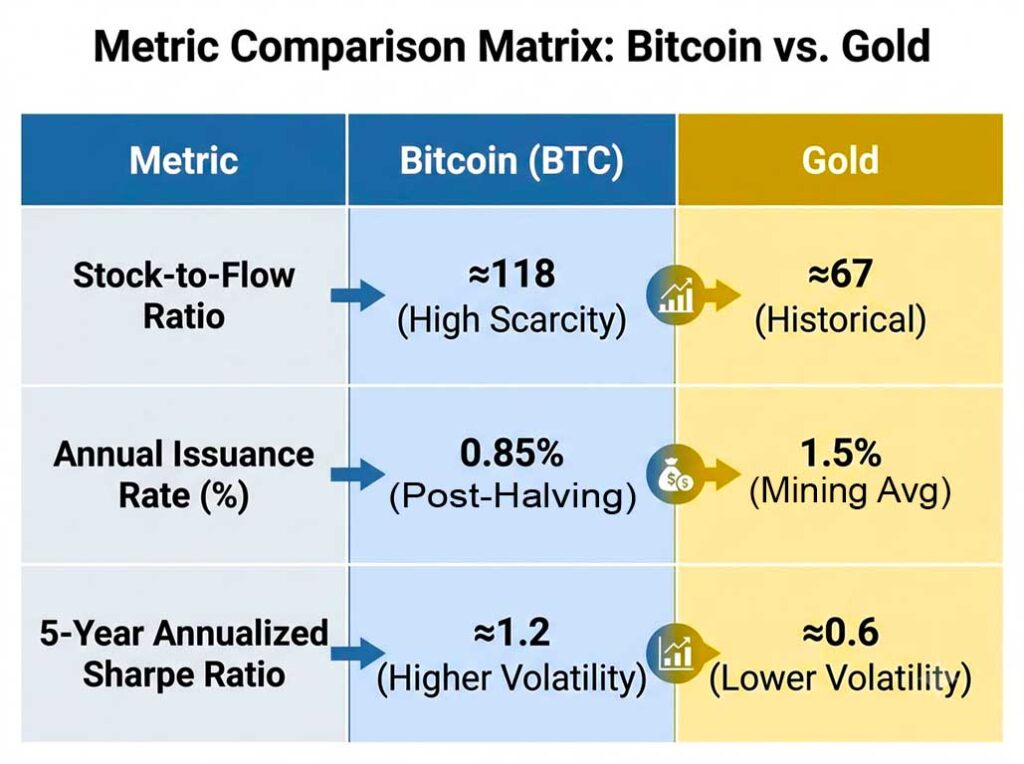
2. Analyzing Gold vs Bitcoin on Core Monetary Attributes
Evaluating both assets across standard monetary criteria reveals complementary strengths rather than mutually exclusive choices:
- Scarcity & Stock-to-Flow: Following the latest Bitcoin halving, Bitcoin’s programmatic supply issuance rate fell below that of gold, making it mathematically the scarcest liquid asset on Earth.
- Portability & Verification: Bitcoin can be transferred globally across borders within minutes with cryptographic certainty, whereas moving and verifying physical gold bullion incurs substantial storage, shipping, and assay costs.
- Historical Track Record & Stability: Gold possesses over 5,000 years of monetary trust and functions with exceptionally low drawdowns during liquidity panics, making it ideal for capital preservation.
Institutional portfolio simulations demonstrate that pairing a small allocation of Bitcoin (2%-5%) with a standard gold position (5%-10%) significantly enhances overall portfolio Sharpe ratios without introducing unmanageable downside risk.
Generational wealth transfer dynamics favor digital assets, as tech-native younger investors increasingly treat decentralized digital tokens as their primary savings vehicle.
3. Final Portfolio Verdict: How to Allocate
Smart investors do not need to choose strictly between physical bullion and digital scarcity. While physical gold protects against extreme systemic banking crises and geopolitical sanctions, Bitcoin offers asymmetric upside participation in the ongoing digitalization of global finance.
Rebalancing profits between the two assets systematically during volatility cycles allows investors to lock in gains and maintain optimal risk exposure.
Ultimately, in the battle of Gold vs Bitcoin, a blended allocation provides the ultimate shield against currency debasement and fiscal expansion.
You Might also find this post insightful – Fed Rate Cuts: The #1 Secret to Profit Now
4. Practical Asset Allocation Blueprint for 2026
Determine your personal risk tolerance and time horizon. Conservative investors prioritizing capital preservation should allocate a larger share toward physical gold bullion or allocated vault storage.
Tech-forward investors seeking asymmetric growth should utilize regulated spot Bitcoin ETFs inside tax-advantaged retirement accounts to capture digital asset appreciation without self-custody complexities.
Finally, implement an annual rebalancing rule. When Bitcoin rallies aggressively, harvest partial gains into gold; conversely, during crypto pullbacks, reallocate into Bitcoin, optimizing your overall risk-adjusted return profile.
💡Further Reading for Investors:
Want to master growth stock valuations and competitive moats? Check out
- The Bitcoin Standard: The Decentralized Alternative to Central Banking
- Broken Money: Why Our Financial System Is Failing Us and How We Can Make It Better
- The Power of Gold: The History of an Obsession
- Principles for Dealing with the Changing World Order: Why Nations Succeed and Fail
- Layered Money: From Gold and Dollars to Bitcoin and Central Bank Digital Currencies
Frequently Asked Questions
Can Bitcoin ever completely replace physical gold?
Unlikely in the near term. Central banks and sovereign treasuries require tangible, offline reserves with thousands of years of legal precedent, ensuring physical gold maintains a permanent bedrock position in global finance.
What is the recommended percentage allocation for a hedge portfolio?
Many institutional wealth managers recommend allocating between 5% and 10% of total liquid net worth to physical gold, combined with a 1% to 5% position in spot Bitcoin ETFs for asymmetric growth.
Authoritative Financial Sources & Disclosures
For official filings, macroeconomic data, and regulatory disclosures, reference the U.S. Securities and Exchange Commission (SEC), the Federal Reserve System, and official corporate investor relations releases.



Pingback: Where Will $6.5 Trillion in Money Market Cash Go?