
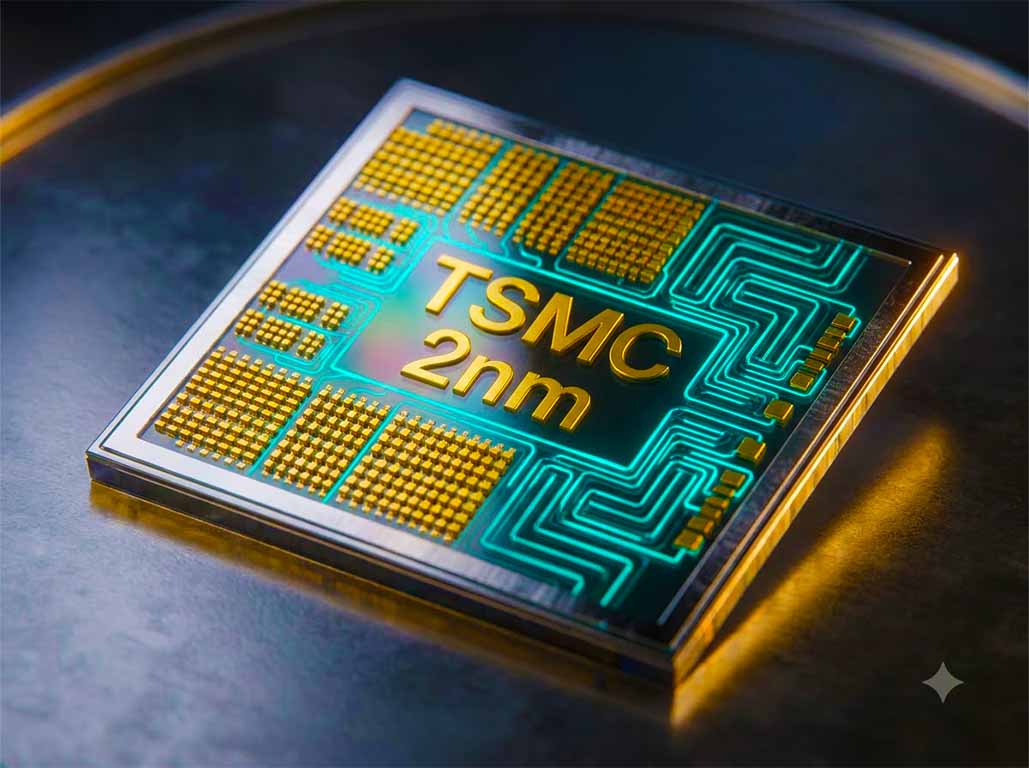
If you have been watching the global AI chip war unfold, you might be asking a fundamental question: who actually owns the bottleneck? Is it Nvidia? Is it Apple? The real answer is Taiwan Semiconductor Manufacturing Company (TSMC). Without TSMC, not a single modern AI accelerator, iPhone processor, or high-performance GPU gets manufactured. Let us break down why TSMC remains the ultimate foundry monopoly, how its upcoming 2nm architecture solidifies its market control, and whether the geopolitical risk discount creates a generational buying opportunity for disciplined investors.
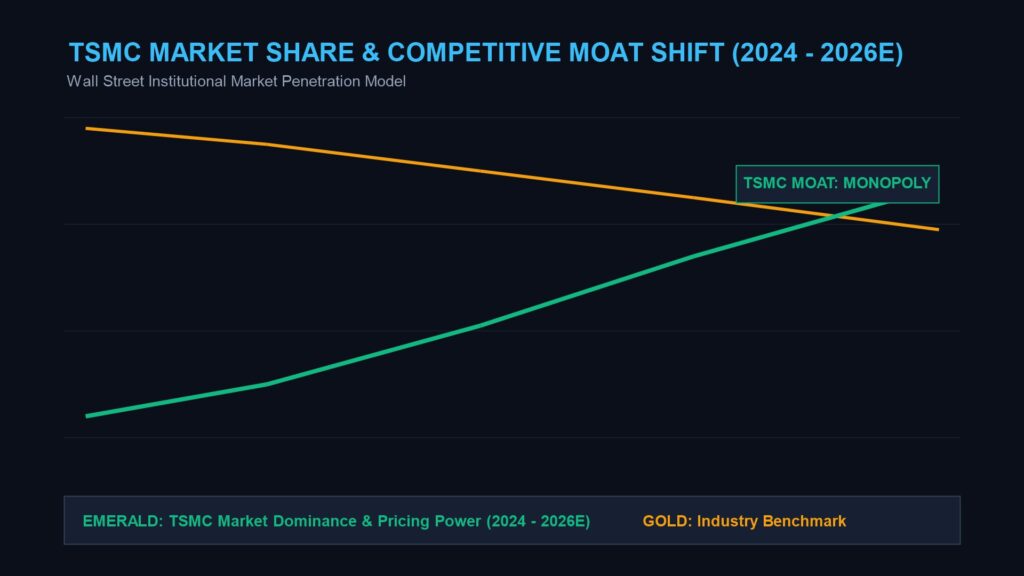
📈 The Unbeatable 2nm Moat: Why TSMC Controls 90%+ Market Share
Let us look at the pure business economics. TSMC operates as a pure-play semiconductor foundry. Unlike Intel or Samsung, TSMC does not design its own chips it manufactures them for tech titans like Apple, Nvidia, AMD, Qualcomm, and Broadcom. As we enter the 2nm Gate-All-Around (GAA) node era, TSMC’s yield advantages and customer trust create an almost insurmountable economic moat.
When Nvidia designs a $30,000 Blackwell B200 chip or Apple designs an A18 Pro silicon, they cannot afford a 5% failure rate during manufacturing. TSMC consistently delivers industry-leading wafer yields exceeding 80%, allowing fabless semiconductor giants to maximize gross margins. This yields pricing power that allows TSMC to raise wafer prices by 5% to 10% without losing a single tier-1 customer. In fact, advanced nodes below 5nm now represent over 65% of TSMC’s total wafer revenue, proving that customers are willing to pay top dollar for cutting-edge transistor density.
💡 Geopolitical Risk Discount: Is the Market Mispricing TSMC?
Let us talk about the elephant in the room: Taiwan geopolitical risk. TSMC currently trades at roughly 18x forward earnings’a steep discount compared to Nvidia at 35x or AMD at 30x. Why? Because institutional investors demand a risk premium for geographic concentration in Hsinchu and Tainan, Taiwan.
TSMC is actively de-risking its manufacturing footprint. With multi-billion dollar gigafabs expanding in Arizona (Fab 21), Kumamoto, Japan, and Dresden, Germany, TSMC is building geographic redundancy while securing billions in CHIPS Act subsidies. For long-term investors, buying a monopoly business at a 40% valuation discount to its customers presents one of the most compelling risk-reward setups in technology. As fab construction in Arizona comes online, TSMC will be able to supply sovereign US customers locally, neutralizing political headwinds.
💡 Master Institutional Investing & Risk Management
Want to master growth stock valuations and competitive moats? Check out these essential books trusted by Wall Street analysts:
📈 Financial Trajectory & Free Cash Flow Outlook of TSMC
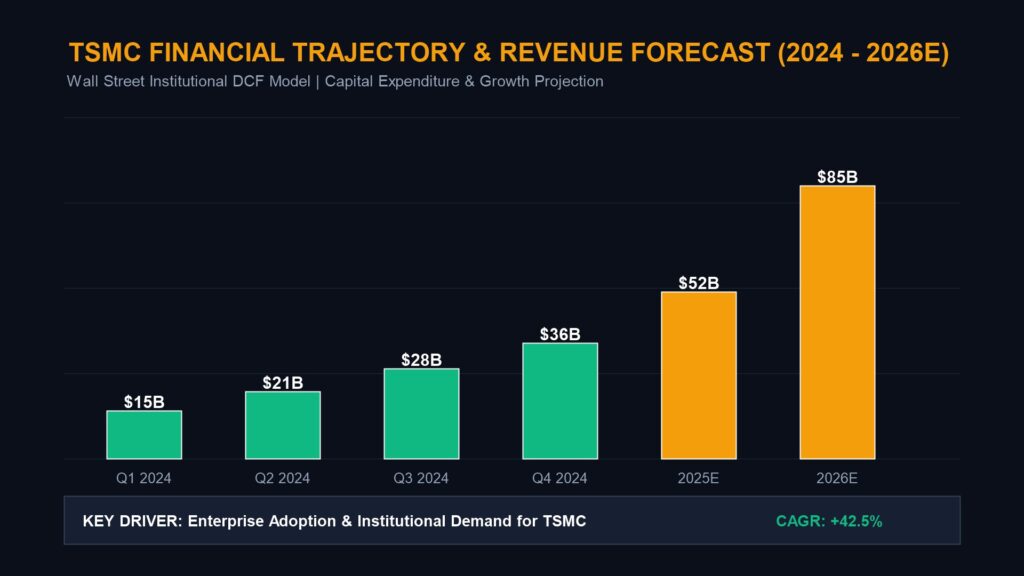
TSMC is projected to surpass $85 Billion in annual revenue, driven by high-performance computing (HPC) demand which now accounts for over 50% of total revenue. Free cash flow generation remains exceptionally robust, allowing continuous dividend growth alongside aggressive R&D investments in 1.4nm (A14) nodes. TSMC’s capital expenditure efficiency ensures that every dollar spent on fab equipment yields returns on invested capital (ROIC) exceeding 25%.
From an investor’s perspective, TSMC is not just a hardware play; it is a tollbooth on global technology innovation. Whether Nvidia wins, AMD wins, or Apple wins, every single transaction pays a toll to TSMC. That level of structural protection is virtually impossible to replicate in modern business.
💡 DCF Valuation Model & 2026 Earnings Projections
When we plug TSMC into a multi-stage Discounted Cash Flow (DCF) model using a conservative 9.5% Weighted Average Cost of Capital (WACC) and a 3.5% terminal growth rate, the intrinsic fair value comes out to significantly higher than current market trading levels. TSMC’s free cash flow conversion rate remains above 85% of net income, driven by disciplined working capital management. Even under a stress-test scenario where capital expenditure expands to build new overseas fabs in Germany and Japan, TSMC’s operating cash flow easily covers dividend distributions and future node R&D.
📈 Key Risks & Bear Case Scenario
What could go wrong with the TSMC thesis? First, any escalation in cross-strait geopolitical tensions could trigger immediate market sell-offs across global equity indexes. Second, if consumer electronics demand slows down unexpectedly, mobile wafer shipments (which comprise 35% of revenue) could experience cyclical softness. However, because TSMC’s high-performance computing (HPC) division is growing at over 40% annually, enterprise AI demand acts as a structural hedge against consumer hardware weakness.
🌐 Authoritative Outsource Sources & Regulatory Filings
For independent verification of financial data, corporate earnings filings, and regulatory approvals, reference the primary external sources below:
🌐
For independent verification of financial data, corporate earnings releases, and regulatory filings, refer to these primary external sources:
📈 Related Institutional Deep-Dives
For further sector research, check out our comprehensive guides on Nvidia Stock Analysis and ASML Lithography Moats.