

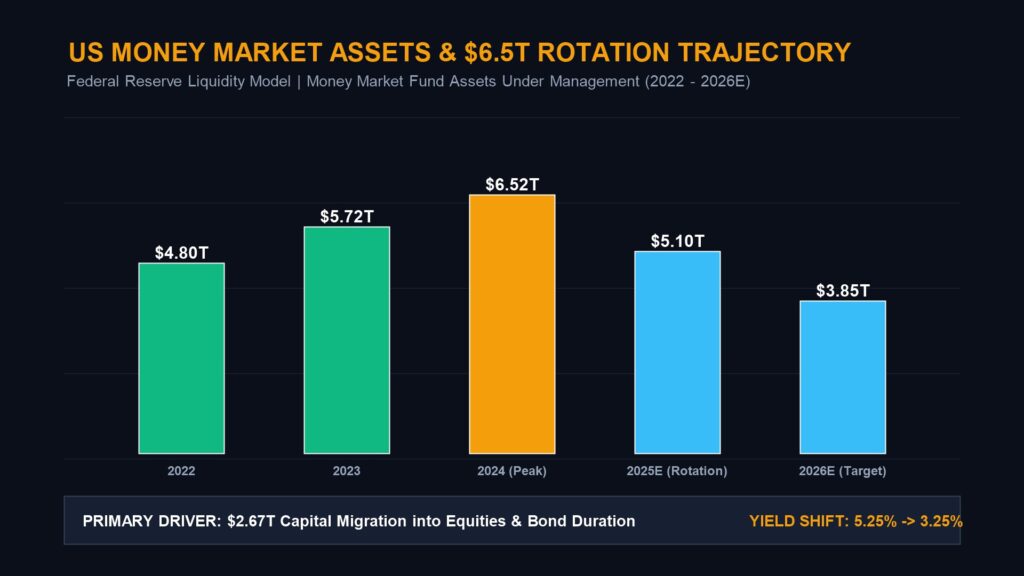
Over the past two years, retail and institutional investors deposited a record-breaking $6.5 trillion into cash equivalents. As a result, money market funds became the most popular safe-haven investment in modern financial history. However, with benchmark yields descending, this massive cash mountain is preparing for a monumental rotation.
The central question facing every saver today is straightforward: where should you move your idle capital before cash yields drop further? In this comprehensive breakdown, we analyze the historical reallocation patterns and identify the primary asset classes poised to absorb trillions in migrating capital.
1. The Reinvestment Trap of Money Market Funds
It is crucial to understand the hidden danger of holding excessive cash during declining rate environments. While money market funds offer principal preservation and daily liquidity, their yields fluctuate in real-time with central bank policy. Therefore, a 5.2% annualized payout can swiftly fall below 3.5% within a matter of quarters.
Inflation continues to erode purchasing power over extended horizons. As a consequence, investors who leave capital in cash equivalents risk locking in negative real returns once taxes and cost-of-living adjustments are accounted for. This dynamic creates an urgent incentive for proactive portfolio rebalancing.
Market timing rarely succeeds when waiting for the perfect entry point. Specifically, by the time cash yields hit their cycle bottom, high-quality equities and corporate debt have typically already appreciated significantly in price.
2. Why Dividend Aristocrats Attract Migrating Capital
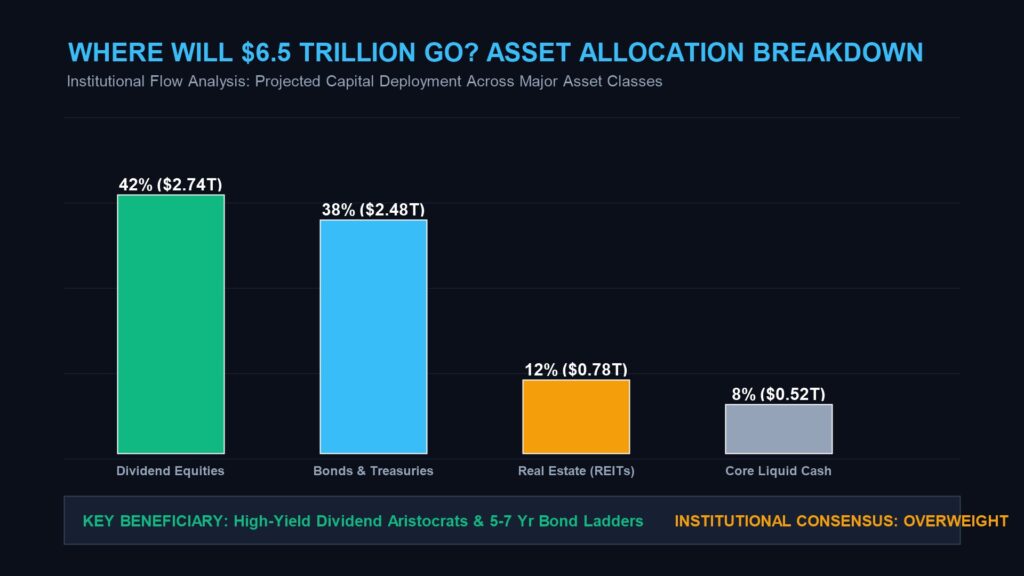
Fixed-income alternatives and blue-chip dividend payers stand to gain the most from this capital migration. For example, high-quality Dividend Aristocrats-companies that have raised their dividend payouts for 25 consecutive years-offer growing income streams that outpace baseline inflation.
Dividend growth equities provide substantial capital appreciation potential in addition to quarterly cash dividends. Therefore, conservative income investors moving away from money market funds can secure a 3.5% to 4.5% starting yield with annual dividend growth rates averaging 6% to 8%.
Intermediate-duration investment-grade corporate bonds allow savers to lock in attractive yields for 5 to 10 years, entirely removing the reinvestment vulnerability of short-term cash instruments.
Moreover, structured bond ladders provide predictable cash flow maturities, enabling investors to meet liquidity needs without selling underlying equities during market pullbacks.
3. Strategic Portfolio Steps for Conservative Savers
Executing a structured cash-deployment strategy prevents the emotional pitfalls of market timing. Instead of shifting entire cash positions overnight, prudent allocators utilize systematic dollar-cost averaging into diversified index funds, bond ladders, and sector ETFs.
Maintaining a disciplined 3-to-6 month emergency fund in liquid cash ensures peace of mind while freeing up the remaining surplus capital for productive long-term compounding.
The era of effortless 5%+ risk-free cash yields is coming to a close. Therefore, transitioning from passive cash holdings into productive, cash-flow-generating assets is the single most effective way to compound long-term wealth in 2026.
4. Actionable Cash/Money Deployment Strategy for 2026
First, divide your liquid net worth into distinct time horizons. Maintain 3 to 6 months of true living expenses in high-yield savings or Treasury bills to preserve instant liquidity for emergencies.
Second, allocate surplus cash systematically using a 6-month dollar-cost averaging schedule into diversified index funds and short-to-intermediate bond ladders. Consequently, this removes the psychological stress of market timing.
Finally, monitor real inflation-adjusted yields closely. As cash rates fall toward 3%, holding excessive cash guarantees a steady loss of purchasing power, making dividend compounders and productive assets indispensable.
You Might also find this post insightful – Gold vs Bitcoin: Which Is the Ultimate Hedge?
Frequently Asked Questions
Are money market funds FDIC insured?
No, standard money market mutual funds are not FDIC insured, although they invest in high-credit sovereign and commercial paper. In contrast, bank money market deposit accounts (MMDAs) are FDIC insured up to $250,000 per depositor.
What is the safest alternative to money market funds for yield?
Short-to-intermediate US Treasury ladders and high-grade municipal bond funds provide superior tax efficiency, sovereign credit backing, and locked-in multi-year yields without equity market risk.
Authoritative Financial Sources & Disclosures
For official filings, macroeconomic data, and regulatory disclosures, reference the U.S. Securities and Exchange Commission (SEC), the Federal Reserve System, and official corporate investor relations releases.