

Federal Reserve shifts its monetary policy stance, every asset class in the global economy feels the ripple effect. Therefore, understanding the mechanics of Fed rate cuts is essential for investors navigating the modern economic landscape. As central bankers adjust the federal funds rate downward, capital begins migrating across asset classes at an unprecedented speed.
Aggressive rate-cutting cycles signal major turning points in the economic cycle. Consequently, investors who position their portfolios ahead of these interest rate transitions frequently capture outsized risk-adjusted returns. In this comprehensive guide, we examine the true impact of rate cuts on equities, the yield curve, and cash allocations.
1. How Fed Rate Cuts Impact the Treasury Yield Curve
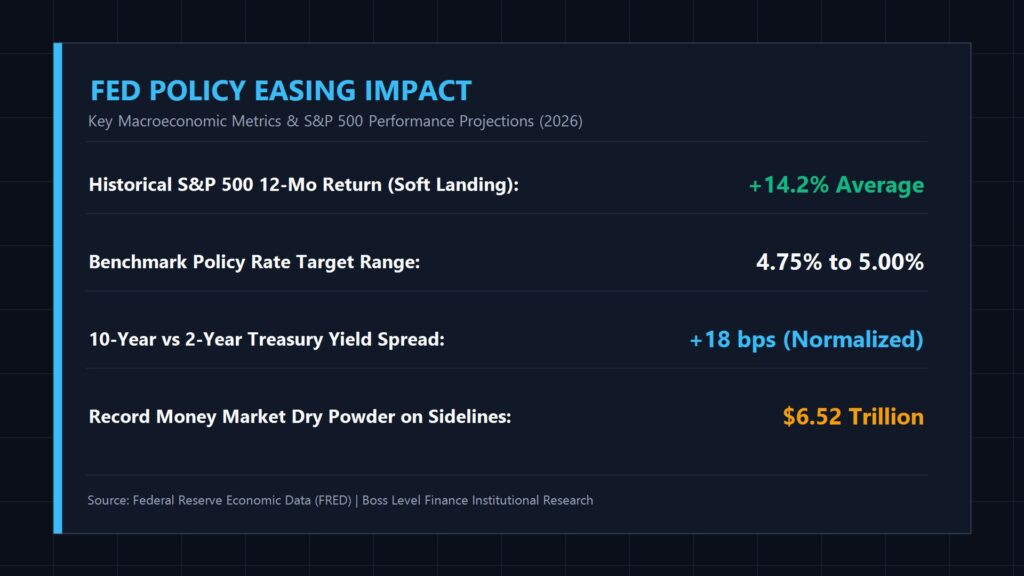
The most immediate consequence of monetary easing is the normalization of the US Treasury yield curve. During restrictive policy phases, short-term yields spike above long-term yields, causing an inverted yield curve. However, as the Fed lowers borrowing costs, short-duration yields drop rapidly, restoring a healthy upward slope.
An un-inverting yield curve significantly alters bank profitability and lending behavior. Specifically, commercial banks borrow short and lend long. Therefore, when short-term funding costs decline, net interest margins expand, encouraging new business lending and consumer credit expansion across the broader economy.
Institutional fixed-income allocators aggressively extend bond duration as yields fall. By purchasing longer-dated sovereign Treasuries and high-grade corporate bonds, fund managers lock in attractive yields while enjoying substantial capital appreciation as bond prices rise inversely to yields.
2. The Equity Winners and Losers Under Fed Rate Cuts
Equity sectors react very differently when interest rates decline. For example, high-growth technology companies and capital-intensive clean energy firms benefit immediately because lower discount rates boost the present value of their future cash flows. Moreover, lower corporate debt refinancing costs directly expand profit margins.
Dividend-paying defensive sectors-such as real estate investment trusts (REITs) and utilities-become significantly more attractive. When cash yields in risk-free Treasury bills drop below 4%, income-seeking investors naturally rotate back into high-yielding equity securities to maintain their purchasing power.
Regional banks that relied heavily on high deposit spreads may face temporary compression before loan demand picks up. Therefore, stock selection within financial equities becomes critical during early easing phases.
You Might also find this post insightful – Is Intuitive Surgical Stock the Best Healthcare Buy?
3. Navigating the $6.5 Trillion Cash Reallocation
Over $6.5 trillion remains parked in US money market funds earning short-term yields. However, as Fed rate cuts take effect, returns on cash equivalents and certificates of deposit (CDs) will decay quickly. Consequently, institutional money managers must deploy this dry powder into high-quality corporate bonds and undervalued blue-chip equities.
Historical flow data reveals that cash rarely sits idle once short-term yields drop by more than 100 basis points. Specifically, retail investors tend to chase rising equity markets, creating powerful secondary momentum in index funds and consumer cyclical stocks.
Holding excessive cash during a monetary easing cycle creates severe reinvestment risk. Investors who lock in attractive multi-year bond yields or allocate into dividend compounders early can protect their income streams against falling benchmark rates.
4. Actionable Steps for Navigating Fed Rate Cuts
First, review your existing fixed-income duration immediately. Because short-term yields fall first during monetary easing cycles, shifting out of cash into 5-to-7 year investment-grade bond funds locks in elevated yields before future cuts occur.
Second, dollar-cost average into dividend-growing equities and quality real estate investment trusts (REITs). Historically, these cash-flow compounders experience substantial capital appreciation as bond yields compress.
Finally, avoid chasing speculative low-quality cyclicals that rely on debt bailouts. Instead, focus on companies with low debt-to-equity ratios and robust free cash flow generation to ensure sustainable outperformance.
💡Further Reading for Investors:
Want to master growth stock valuations and competitive moats? Check out
- Mastering the Market Cycle: Getting the Odds on Your Side
- The Lords of Easy Money: How the Federal Reserve Broke the American Economy
- Principles for Navigating Big Debt Crises
- The Bond Book: Everything You Need to Know About Treasuries, Corporates, and Funds
- Expected Returns: An Investor’s Guide to Harvesting Market Rewards
Frequently Asked Questions
Do stocks always go up after the Fed cuts interest rates?
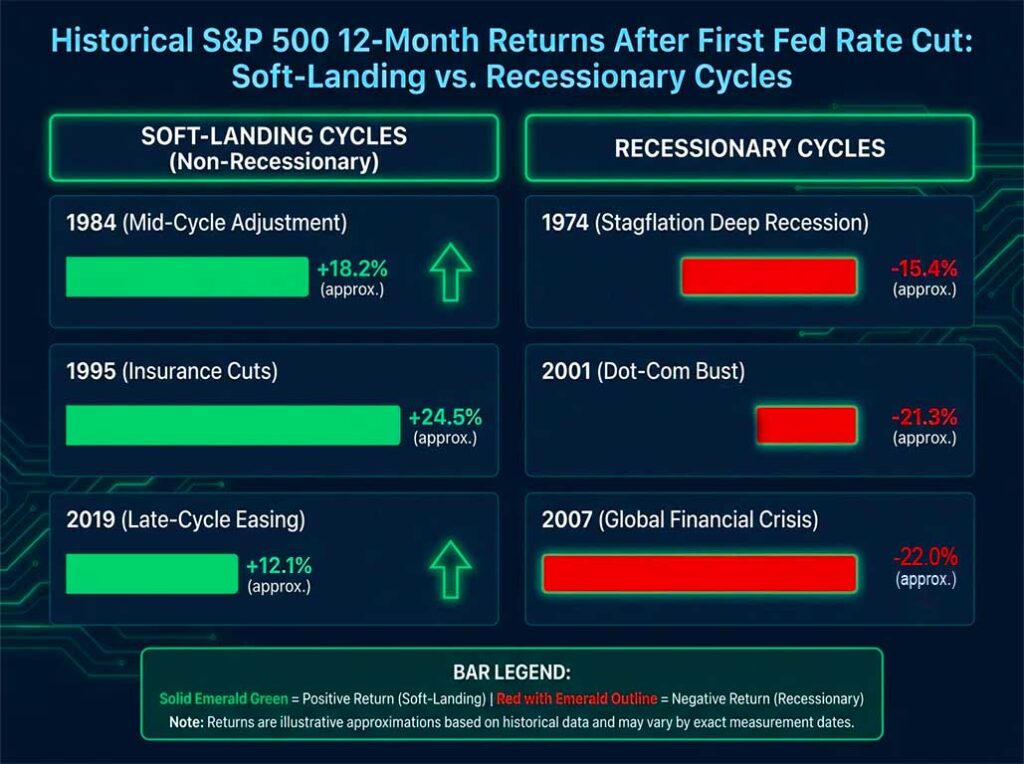
Stock market performance depends heavily on the macroeconomic backdrop. When cuts occur during a resilient economy (“soft landing”), equities historically generate double-digit 12-month gains. However, if cuts are emergency responses to a severe recession, corporate earnings contractions can create short-term market turbulence before recovery takes hold.
How do rate cuts affect mortgage rates and housing?
While mortgage rates are primarily pegged to 10-year Treasury yields rather than the overnight Fed funds rate, easing monetary policy puts downward pressure on home loan financing costs. As a result, refinancing activity surges and homebuyer affordability improves substantially.
Authoritative Financial Sources & Disclosures
For official filings, macroeconomic data, and regulatory disclosures, reference the U.S. Securities and Exchange Commission (SEC), the Federal Reserve System, and official corporate investor relations releases.


Pingback: Gold vs Bitcoin: Which Is the Ultimate Hedge?