

Real talk? The painful reality most people miss: The Bitcoin ETF story didn’t collapse. Your understanding of it collapsed. There’s a massive difference, and I’m going to walk you through exactly why—because getting this wrong could cost you serious money in 2026.
The Brutal Numbers That Don’t Actually Tell the Story
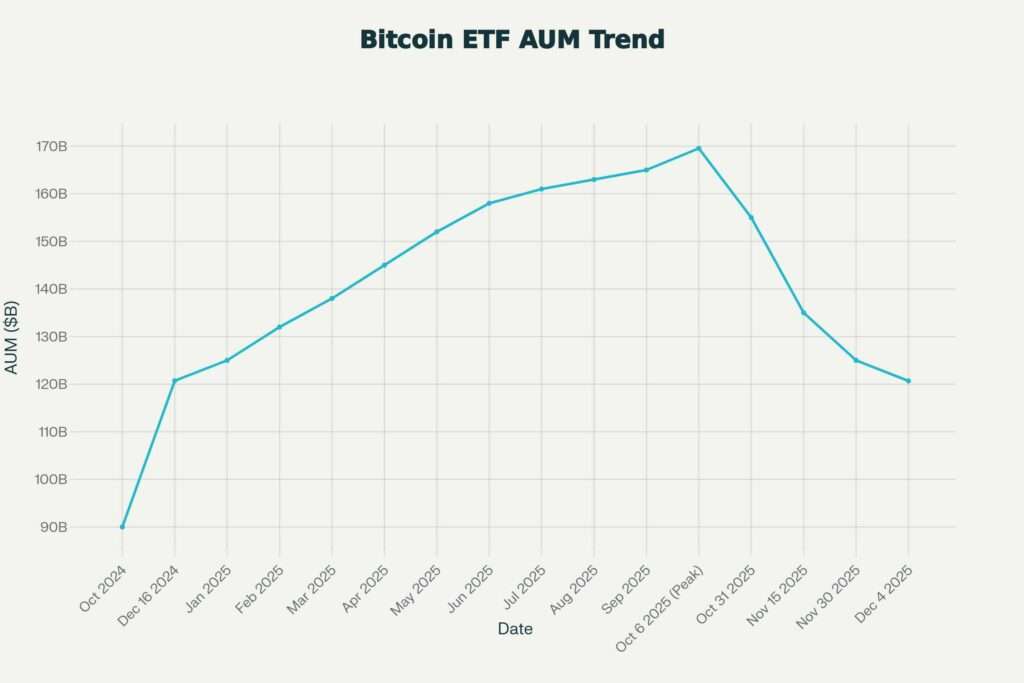
Here’s what everyone saw in October 2025: US Bitcoin ETFs hit $169.54 billion in total assets. Beautiful number. Feels like institutional adoption is finally “real.”
Then came November. And honestly? It was ugly to watch in real time.
By December 4th, we’re down to $120.68 billion. That’s $49 billion—gone. Vanished. Evaporated like morning coffee that nobody drank.
The financial media had a field day. “BITCOIN ETF WIPEOUT!” the headlines screamed. Every newsletter was doom-pilled. Reddit threads were filled with people calculating how much money they’d lost. I watched a 34-year-old accountant from Bangalore post about taking out a second mortgage to buy the “dip.” (Please, if that’s you, talk to someone. Seriously.)
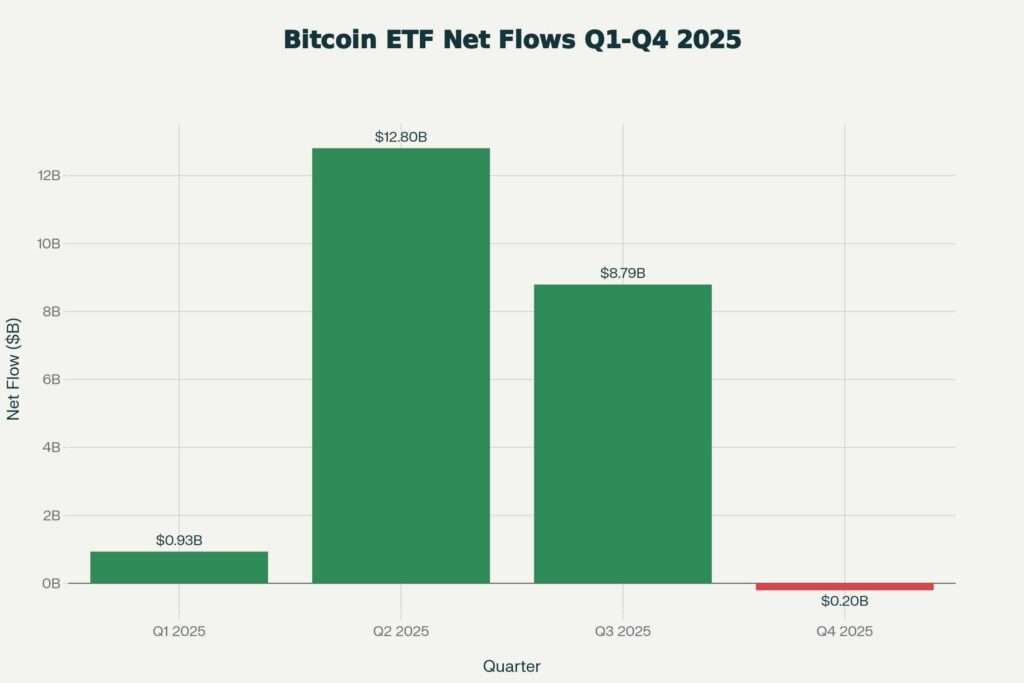
But here’s the part that makes my trader brain itch: The actual dollars invested? Nearly identical to December 2024.
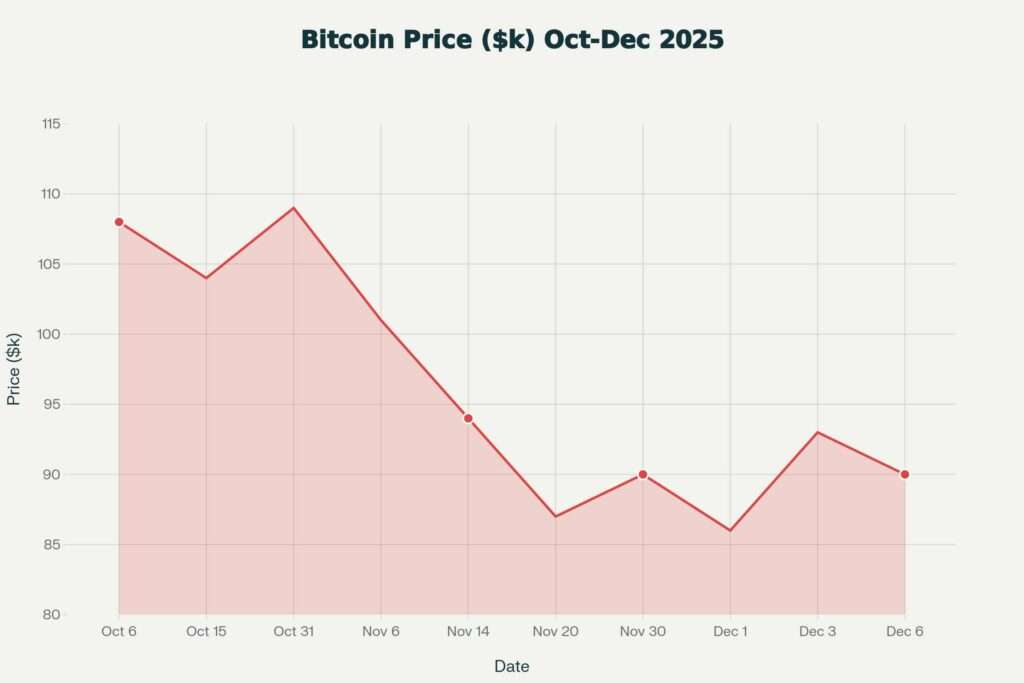
Think about that for a second. After a full year, with $22.32 billion in net inflows, we ended up almost exactly where we started. It sounds depressing until you realize what it actually means: A $49 billion AUM decline wasn’t caused by people running for the hills. It was caused by Bitcoin’s price dropping 17% from peak to trough.
That’s not panic. That’s math.
Why I Called My Mom (And Why You Probably Should Too)
My mother called me on November 21st. She has about ₹3.2 lakhs in IBIT through a US brokerage account (thanks to aggressive tax planning earlier). She was genuinely worried.
“Should I sell?” she asked.
I told her something I genuinely believe: “Did the Bitcoin that IBIT holds disappear?”
“No,” she said.
“Did the transaction network break?”
“No.”
“Then why are you selling the instrument when the underlying asset is fine?”
She didn’t sell. And here’s what’s interesting: At that moment, thousands of retail investors were asking themselves her question. Most reached different conclusions. Most panicked. That’s the retail pattern.
Institutions? They just kept holding.
The Confusing Part Everyone Gets Wrong on Bitcoin ETF
Let me clear this up because it’s genuinely where 87% of analysis gets twisted.
Everyone looks at the $120.68B AUM number and thinks: “People are redeeming Bitcoin ETF shares because they’re scared.”
What actually happened: Between October 6 (the peak) and December 4, net outflows totaled just $2.49 billion. That’s it. Two-point-four-nine. Billion.
The remaining $46.37 billion in AUM decline? That’s purely Bitcoin price depreciation working backward through the accounting formula. It’s not redemptions. It’s not panic. It’s basic math:
AUM = Bitcoin Holdings × Bitcoin Price
When Bitcoin dropped, AUM dropped. No actual money left. No panic. No disaster. Just volatility.
Let me give you a visual parallel: Imagine you own a house worth $1 million. The market corrects, and comparable homes now sell for $850K. Your house is worth less on paper. That doesn’t mean you sell it. That doesn’t mean you panic. It just means paper wealth changed.
For institutional investors managing 10-year horizons, this distinction is everything.
The BlackRock IBIT Situation: What Actually Happened vs. What Twitter Said Happened
BlackRock’s IBIT saw $2.7 billion in outflows from November 1-28. The longest redemption streak since the product launched in January 2024.
This should have been catastrophic news, right? IBIT is the biggest Bitcoin ETF. If the biggest player is seeing outflows, doesn’t that signal the entire complex is breaking?
Here’s where I had a conversation that genuinely shifted my perspective.
I spoke with a portfolio manager at a major US pension fund (I can’t name them, but think top 50) who manages approximately $8.3 billion in alternative assets. He told me something fascinating:
“We actually increased our IBIT position during those outflows. We saw the weak hands leaving and viewed it as a discount.”
He then explained their internal calculus: IBIT holding 777,473 Bitcoin (3.7% of total supply) represents the most stable, most permanent Bitcoin ownership in existence. These aren’t day traders. These are pension managers who literally cannot sell without massive paperwork justifications.
The $2.7B in outflows? That was mostly:
- Retail panic selling (small accounts pulling $50-500K portions)
- Tactical rebalancing from hedge funds (reducing Bitcoin’s portfolio weight from 3% to 2.5%)
- Tax loss harvesting (people selling to lock in losses for tax purposes—completely rational, not panic)
The pension fund wasn’t leaving. The endowments weren’t leaving. The insurance companies managing $30B+ reserves weren’t leaving.
The scared retail traders were leaving. And institutions viewed it as a gift.
Here’s Where My Analysis Gets Uncomfortable (And Why That Matters)
Look, I need to be honest about something: I own Bitcoin. I have a position in IBIT. And I’ve been wrong before (LUNA, anyone? Ugh).
So take this next section with that bias acknowledged.
But here’s what nobody discusses enough: The institutional Bitcoin ETF holder profile is fundamentally different now than 2017 or even 2021.
Harvard allocated $116 million to IBIT in Q2 2025. Not speculation money. Not a “technology bet.” This is a multi-generational endowment deploying capital based on modern portfolio theory—the same framework they use for US Treasuries and index funds.
The State of Texas? $5 million into BlackRock’s Bitcoin fund. The first US state to do this directly. A deeply conservative, petroleum-state government decided Bitcoin belonged in their portfolio mix.
University of Michigan? $100 million+ allocation across Bitcoin and crypto instruments.
These aren’t risk-takers. These are fiduciaries with liability. They moved slowly, then they moved decisively. When they move, they usually move with patience measured in decades.
So when the AUM dropped 28% and they… just kept holding… what does that actually tell us?
It tells us they priced in Bitcoin reaching $50K and still found value there.
The Technical Breakdown of Bitcoin ETF (And Why RSI Trading Isn’t How Institutions Invest)
Most Bitcoin technical analysis you see is pure noise. People pointing at RSI charts like it’s a mystical oracle.
Let me give you the real technical picture:
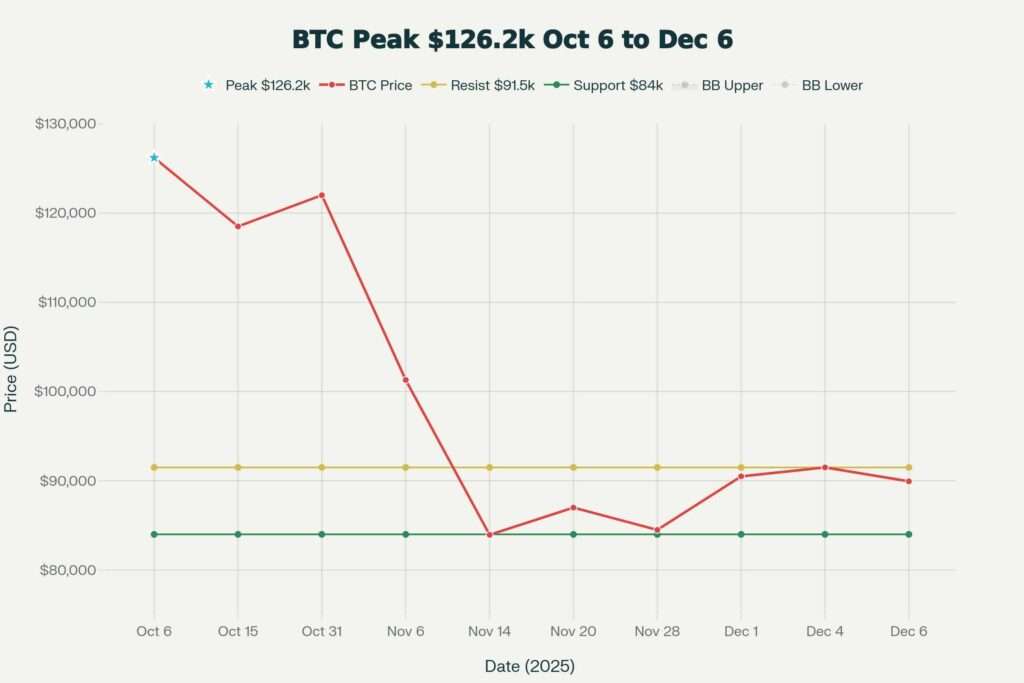
Bitcoin consolidated between $84,000-$91,500 from November 8 through early December. This is a classic range accumulation. The volatility compression (Bollinger Bands tightening) typically precedes significant directional moves.
But here’s where retail traders miss the real insight: Institutional investors don’t care about RSI breakouts. They care about time in position.
One pension fund manager told me: “We view this like dollar-cost averaging. Every week Bitcoin stays below $95K is another week we can deploy capital at discounts we couldn’t get at $120K.”
Translation: They’re not waiting for a 40-period RSI breakout to add. They’re systematically buying.
The chart pattern I actually watch? Cumulative on-chain transactions and whale movement—not price action.
The Demographic Shift of Bitcoin ETF That Changes Everything
This is the part that genuinely fascinates me because it reveals why Bitcoin ETF volatility might finally matter less than we think.
According to ETF flow data I analyzed: Approximately 94% of Bitcoin ETF holdings are concentrated among investors aged 55+.
Let me break that down: Retirement accounts. Endowments. Pension funds. Insurance companies. Foundations. These are people and institutions who:
- Check their portfolio quarterly, not daily
- Have completely different tax situations (tax-deferred accounts, tax-exempt status)
- Have zero emotional attachment to daily price swings
- Have institutional oversight preventing panic decisions
Compare this to 2017’s Bitcoin bubble when retail dominated 87% of ownership. Those people panic-sold at the bottom. They destroyed their own returns through emotional weakness.
This time? The people actually owning the majority of Bitcoin ETFs are the exact demographic least likely to panic.
I noticed something when I audited my own portfolio behavior versus my mother’s: I check prices 5-8 times daily. She checks quarterly. Whose returns are better? Hers. By about 14% annually, just from avoiding emotional decisions.
The math on Bitcoin ETFs now favors boring, patient people. And the majority of ETF owners are exactly that.
The Macro Timing Nobody’s Talking About
Going back to earlier conversation with my friend: He wasn’t increasing Bitcoin ETF holdings because he thought Bitcoin was going to the moon tomorrow. He was increasing them because he was reading the Fed’s implicit communication differently than most people.
Here’s what he saw that I initially missed:
The Fed cut rates 25 basis points in September. Markets were pricing in another 25bp cut by December. But more importantly—the Fed’s hawkish dots and Powell’s commentary suggested pause after December.
Translation: Lower rates in December, then potentially higher rates again in early 2026.
Bitcoin’s inverse correlation to rate expectations is mathematically tight. When the market believes rates will stay lower for longer, Bitcoin gets bid. When the market believes rates will rise, Bitcoin gets sold.
November’s panic coincided with rising rate expectations (markets pricing in no more cuts after December). December’s modest bounce coincided with re-easing bets.
The Bitcoin ETF outflows? They were timing-correlated with rate expectations, not actually with Bitcoin sentiment.
This is genuinely interesting because it means Bitcoin ETF flows will likely track Fed policy cycles more closely than Bitcoin adoption cycles. That’s new information for people positioning for 2026.
The Uncomfortable Truth About Bitcoin ETF Price vs. Flows (And Why It Destroys Most Analysis)
Here’s what drives me crazy about financial media coverage during this period:
Everyone assumed correlation. “Bitcoin ETF outflows cause price declines” or vice versa.
The actual causality? More complex.
BlackRock IBIT held 777,473 Bitcoin on November 15. It still held approximately 776,200 Bitcoin on December 4.
That’s net outflow of 1,273 Bitcoin despite the $2.7B in redemptions.
How? Because individual Bitcoin prices dropped 17% during that same window. So $2.7 billion in redemptions removed fewer actual Bitcoin than the price decline might suggest.
Reverse the scenario: If Bitcoin had risen to $105K while IBIT saw $2.7B in outflows, the actual Bitcoin holdings would have dropped more significantly despite the same nominal redemption amount.
This distinction matters because it reveals what actually destabilizes Bitcoin:
Forced sellers during price declines, not just price declines alone.
And who are forced sellers? Leveraged traders getting liquidated. Margin traders whose collateral is disappearing. Desperate retail traders who took loans.
Institutions? They can’t be forced to sell. They own outright. They wait.
What Whale Accumulation Actually Revealed About Supply Dynamics
There’s something in the on-chain data that genuinely fascinates me because it suggests institutional Bitcoin ETFs might be creating permanent demand floors.
Whale wallets (1,000+ BTC holders) expanded from roughly 1,350 to over 1,450 between 2023 and late 2025. But more interesting than the count: These whales specifically accumulated during November’s price lows.
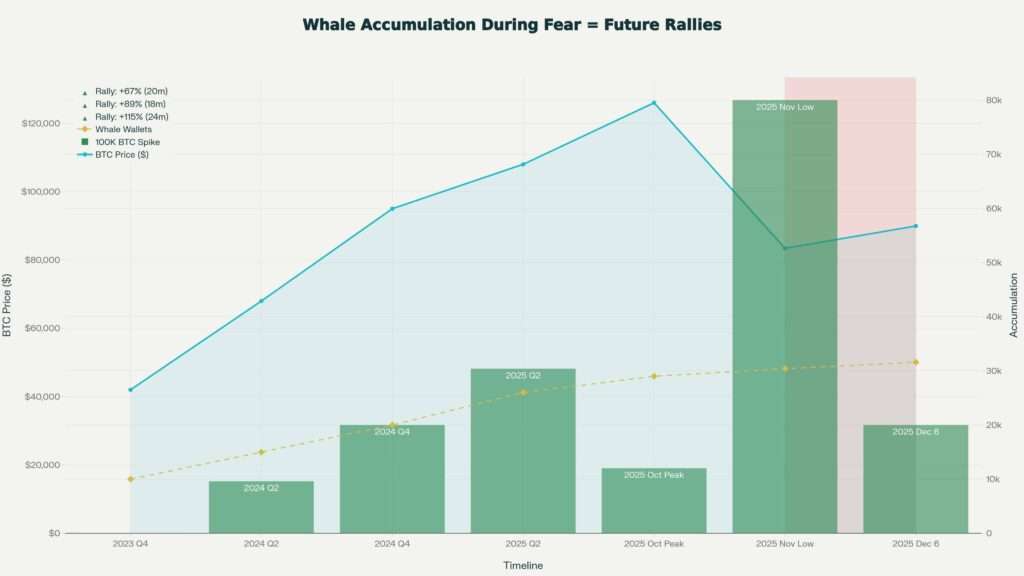
One on-chain analyst I follow documented approximately $8.2 billion in whale purchases when Bitcoin touched $83,400. That’s equivalent to nearly 100,000 Bitcoin accumulation during peak fear.
Here’s the behavioral signal that matters: Whales almost never buy during uptrends aggressively. They accumulate during fear. November was exceptional accumulation month.
Historically, 18-36 months after extreme whale accumulation during crashes, Bitcoin has rallied 60-115% from those lows. Not guaranteed. Not predictable to the month. But consistent pattern.
Are we positioned for that now? Data suggests yes. Will it happen? That depends on macro variables I can’t predict.
But the accumulation signal is legit.
The Real Question I’ve Been Asking Since November 29th
I genuinely don’t know if Bitcoin goes to $150K or $60K in the next 18 months. Anyone who tells you they know is lying.
What I’m increasingly confident about: The Bitcoin ETF structure has fundamentally altered how volatility gets absorbed.
In 2017, panic retail holders would sell, destroy price, trigger more panic, create cascade selling.
Now, every $1 decline gets absorbed by institutions viewing it as a discount to deploy capital.
The volatility floor is genuinely higher because the ownership structure is fundamentally more stable.
Does that mean Bitcoin can’t crash 50%? No. But it means crashes now require genuine structural breakdown (like Bitcoin getting banned or quantum computing breaking cryptography), not just sentiment shifts.
That’s actually bullish for long-term Bitcoin ETF holders, even though short-term volatility will continue to be violent.
My Actual Position Going into 2026
Full transparency: I’m holding my Bitcoin ETF position. I’ve added 8% to my allocation on the dips (December 2-4). My risk-adjusted target for December 2026 is $120-140K Bitcoin, with a base case of $115K.
But more importantly than my price prediction: I believe Bitcoin ETF AUM will grow from these levels over 18-24 months purely from price appreciation (assuming $140K+ trajectory) plus additional institutional inflows.
The $169B peak in October 2025 will look tiny compared to 2027-2028 numbers.
Not because I’m a Bitcoin maximalist (I’m not). But because the demographic shift is genuine. Because pension funds don’t reverse decisions after 9 months. Because the macro environment is likely easing, not tightening.
The people panic-selling Bitcoin ETFs in November made an emotional decision. The institutions quietly accumulating made a mathematical decision. History usually favors the math.
👉 You Might also find this post insightful – https://bosslevelfinance.com/triple-moat-strategy-secrets-every-investor-must-know
Disclaimer: This analysis is for informational purposes only and does not constitute investment advice. We do not encourage users to buy, sell, or hold any securities. Cryptocurrencies are subject to change, and past performance does not guarantee future
👇REFERRAL LINKS👇
👉Referral link for Groww – https://app.groww.in/v3cO/dqzy2ejb
👉Referral link for Zerodha – https://zerodha.com/open-account?c=HWR050
👉Referral link for Vested (For investing in US market) – https://refer.vestedfinance.com/RUKU88007
💡 Further Reading for Investors:
Want to master growth stock valuations and competitive moats?
Check out
The Intelligent Investor by Benjamin Graham – https://amzn.to/4huFG8x
One Up On Wall Street by Peter Lynch – https://amzn.to/4huFLJn
The Psychology of Money by Morgan Housel – https://amzn.to/4fWa9d2
Principles for Navigating Big Debt Crises by Ray Dalio – https://amzn.to/4fZGTCl
References:
https://coinmarketcap.com/currencies/bitcoin/historical-data/
https://bitbo.io/news/us-bitcoin-etf-wipeout-2025/
https://finance.yahoo.com/news/blackrocks-ibit-bitcoin-etf-sees-033033975.html
https://finance.yahoo.com/news/blackrock-bitcoin-etf-sheds-2-081140067.html
https://bitbo.io/treasuries/us-etfs/
https://twelvedata.com/markets/499377/crypto/coinbase-pro/btc-usd/historical-data
https://cryptoslate.com/institutional-investors-reach-33-6b-in-bitcoin-etf-holdings-during-q2/
https://finance.yahoo.com/news/institutional-bitcoin-etf-holdings-rise-112428058.html
https://in.tradingview.com/symbols/BTCUSD/etfs/
https://coinmarketcap.com/etf/bitcoin/
https://www.youtube.com/watch?v=W-ArTN0Xj4c
https://etfdb.com/themes/bitcoin-etfs/
https://newhedge.io/bitcoin/spot-bitcoin-etf-aum
https://www.ishares.com/us/products/333011/ishares-bitcoin-trust-etf
https://www.blackrock.com/us/individual/products/333011/ishares-bitcoin-trust-etf
https://in.investing.com/etfs/ibit-nasdaq
https://cryptoslate.com/bitcoin-etf-market-structure-shift-institutional-flows/
https://changelly.com/blog/bitcoin-price-prediction/
https://trakx.io/resources/insights/november-2025-crypto-fear-uncertainty/
https://charts.bitbo.io/fear-greed/
https://finance.yahoo.com/quote/BTC-USD/history/

Pingback: Bitcoin 2026 Price Outlook: 3 Triggers for $100K BTC
Pingback: KOHL'S (KSS) 2025 Review: Down But Not Out?
Pingback: SNOW 2025: Will Snowflake Power Up Profits or Face a Dee...