

The Fed rate cuts strategy being implemented throughout 2026 marks a pivotal macroeconomic inflection point for income-oriented stock market investors. Consequently, institutional capital is rapidly reallocating out of short-term cash equivalents and money market funds into high-yielding equity assets. Furthermore, as the Federal Reserve lowers benchmark borrowing costs, capital-intensive sectors such as Real Estate Investment Trusts (REITs), regulated utilities, and telecom infrastructure encounter immediate debt service relief alongside massive valuation multiple expansion.
Investors who remained parked in risk-free 5% cash yields over the past two years are now facing severe reinvestment risk as money market rates decline sharply. Therefore, locking in sustainable 5% to 8% dividend yields today offers both reliable passive income growth and double-digit capital appreciation potential. Below, we examine the macroeconomic mechanics of Federal Reserve monetary easing and break down the top 3 high-yield dividend stocks positioned to surge as rate cuts unfold.
Why Fed Rate Cuts Trigger a Massive High-Yield Equity Rally
Understanding how the central bank monetary policy transmission mechanism impacts dividend-paying equities is essential for long-term portfolio optimization. Historically, when the Federal Reserve cuts the federal funds rate, corporate borrowing spreads tighten and dividend yields become dramatically more attractive relative to falling 10-Year Treasury yields.
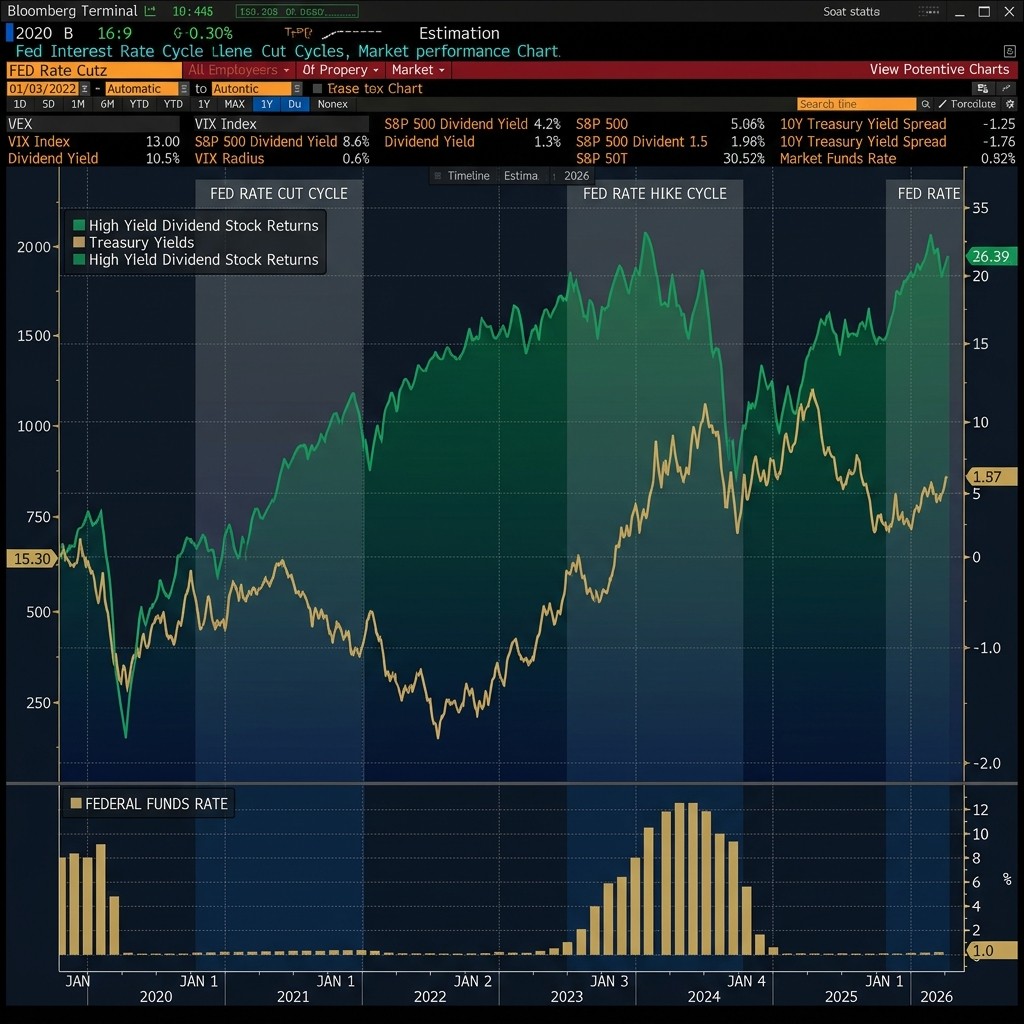
Specifically, Federal Reserve monetary policy easing impacts capital-intensive sectors through three core channels:
- Reduced Interest Expense & Debt Refinancing Relief: Capital-intensive business models that rely on floating-rate credit facilities or frequent debt issuance experience immediate earnings margin expansion as interest expenses drop.
- Multiple Expansion (Valuation Re-rating): As risk-free yields drop from 5% toward 3%, investors discount future dividend cash flows at lower discount rates. This structural shift expands price-to-earnings (P/E) and price-to-FFO (Funds From Operations) multiples across yield sectors.
- Institutional Capital Rotation: Trillions of dollars currently residing in high-yield savings accounts and Treasury bills must find substitute yield assets. This inevitable capital migration drives massive institutional demand for high-quality dividend-paying stocks.
Top 3 High-Yield Dividend Stocks to Buy for 2026 Rate Cuts
To capitalize on upcoming central bank rate cuts, investors should prioritize blue-chip equity issuers with fortress balance sheets, long-standing dividend growth histories, and resilient free cash flow coverage. Here are the top 3 high-yield stocks set to outperform.
1. Realty Income Corporation (NYSE: O) Yield: 5.7%
Realty Income Corporation, known as “The Monthly Dividend Company,” is a premier triple-net lease Real Estate Investment Trust (REIT) holding a diversified commercial real estate portfolio exceeding 15,400 properties across the United States and Europe. Because Realty Income operates under triple-net lease agreements, tenants are responsible for property taxes, insurance, and maintenance expenses, granting Realty Income exceptionally stable 98.8% occupancy rates and predictable operational cash flows.
As the Federal Reserve executes ongoing rate cuts, Realty Income benefits directly through reduced capital costs for accretive property acquisitions. Furthermore, Realty Income has increased its dividend payout for over 105 consecutive quarters, backed by a conservative Adjusted Funds From Operations (AFFO) payout ratio of 75%. As real estate yields compress, O stock is prime for substantial upward valuation re-rating.
2. NextEra Energy, Inc. (NYSE: NEE) Yield: 4.6%
NextEra Energy is the world’s largest generator of renewable energy from wind and solar, alongside its regulated utility subsidiary Florida Power & Light (FPL). Utilities are traditionally heavy corporate borrowers; consequently, high interest rates created a severe valuation drag on NEE stock throughout 2024 and 2025. However, incoming rate cuts eliminate this headwind, allowing NextEra to finance its multi-billion-dollar clean energy infrastructure pipeline at significantly reduced borrowing rates.
Additionally, NextEra Energy is uniquely positioned to supply the immense electrical power demand required by AI data center expansion across the Sunbelt region. Management maintains an industry-leading 10% annual dividend growth guidance through 2026, supported by strong earnings per share (EPS) growth projections of 6% to 8% annually.
3. Verizon Communications Inc. (NYSE: VZ) Yield: 6.4%
Verizon Communications operates as an indispensable telecommunications giant, delivering high-speed 5G broadband and wireless connectivity to over 115 million consumer subscribers. Telekom infrastructure requires massive initial capital expenditure, resulting in substantial debt loads. As rate cuts progress, Verizon’s debt refinancing costs decrease dramatically, directly boosting net income and free cash flow generation.
Verizon currently offers an attractive 6.4% dividend yield supported by $18 billion in annual free cash flow (FCF), representing a secure FCF dividend payout ratio under 60%. With 18 consecutive years of dividend increases, VZ offers investors an exceptional margin of safety and income stability as central bank rate cuts accelerate.
You might also like – https://bosslevelfinance.com/how-to-profit-from-the-sp-500-in-2026
Comparative Financial Analysis: Top 3 High-Yield Dividend Stocks
The comparative financial table below highlights key valuation, yield, and dividend coverage metrics across Realty Income, NextEra Energy, and Verizon Communications:
| Stock Ticker | Sector | Current Yield | Payout Ratio (AFFO / FCF) | Forward P/E / P/FFO | Dividend Streak |
|---|---|---|---|---|---|
| Realty Income (NYSE: O) | Triple-Net REIT | 5.7% | 75% (AFFO) | 12.8x P/AFFO | 105 Consecutive Quarters |
| NextEra Energy (NYSE: NEE) | Regulated Utility / Renewables | 4.6% | 68% (EPS) | 15.2x Forward P/E | 29 Consecutive Years |
| Verizon (NYSE: VZ) | Telecom Infrastructure | 6.4% | 58% (FCF) | 8.9x Forward P/E | 18 Consecutive Years |
Strategic Portfolio Implementation & Risk Management
While central bank rate cuts provide strong macroeconomic tailwinds for high-yield dividend stocks, prudent investors should implement disciplined risk management frameworks. Building a resilient income portfolio requires strict asset allocation limits and ongoing balance sheet monitoring.
- Sector Diversification: Avoid concentrating capital in a single yield sector. Allocating across REITs, utilities, and telecommunications ensures exposure to non-correlated revenue streams.
- Monitor Free Cash Flow Payout Ratios: Prioritize companies that maintain dividend payout ratios below 75% of FCF or AFFO, ensuring ample liquidity to absorb economic downturns.
- Dollar-Cost Averaging (DCA): Scale into equity positions systematically across rate cut announcements to mitigate short-term market volatility and optimize average entry prices.
Conclusion: Capitalizing on the 2026 Rate Cut Cycle
The Federal Reserve monetary easing cycle creates a golden opportunity for income investors to capture attractive yields while benefiting from capital appreciation as rate cuts unfold. By focusing on high-quality dividend growth leaders like Realty Income (O), NextEra Energy (NEE), and Verizon Communications (VZ), investors can secure reliable monthly and quarterly income streams capable of compounding wealth effectively throughout 2026 and beyond.
💡 Further Reading for Investors:
Want to master growth stock valuations and competitive moats?
Check out
The Intelligent Investor by Benjamin Graham – https://amzn.to/4huFG8x
One Up On Wall Street by Peter Lynch – https://amzn.to/4huFLJn
The Psychology of Money by Morgan Housel – https://amzn.to/4fWa9d2
Principles for Navigating Big Debt Crises by Ray Dalio – https://amzn.to/4fZGTCl



Pingback: US Inflation: 3 Recession-Proof Stocks to Buy