
Berkshire Hathaway 2026 market developments took center stage across global financial headlines following the release of Warren Buffett and CEO Greg Abel’s official Q2 earnings report. Consequently, institutional investors, hedge fund managers, and retail traders are analyzing why the Omaha conglomerate experienced a massive surge in market search interest. Firstly, elevated federal funds rates continue shaping institutional cash allocation strategies, making Berkshire Hathaway’s structural shifts crucial for macroeconomic forecasting and portfolio risk management.
1. Operating Earnings Surge to $12.98 Billion Driven by GEICO Recovery
Firstly, Berkshire Hathaway 2026 operating performance delivered a strong 16% year-over-year increase, reaching approximately $12.98 billion for the second quarter. This robust operational growth was anchored by record underwriting profits at GEICO and substantial short-term treasury yield income. Moreover, persistent high interest rates executed by the Federal Reserve allowed Berkshire to generate billions in virtually risk-free income from its U.S. Treasury bill holdings.
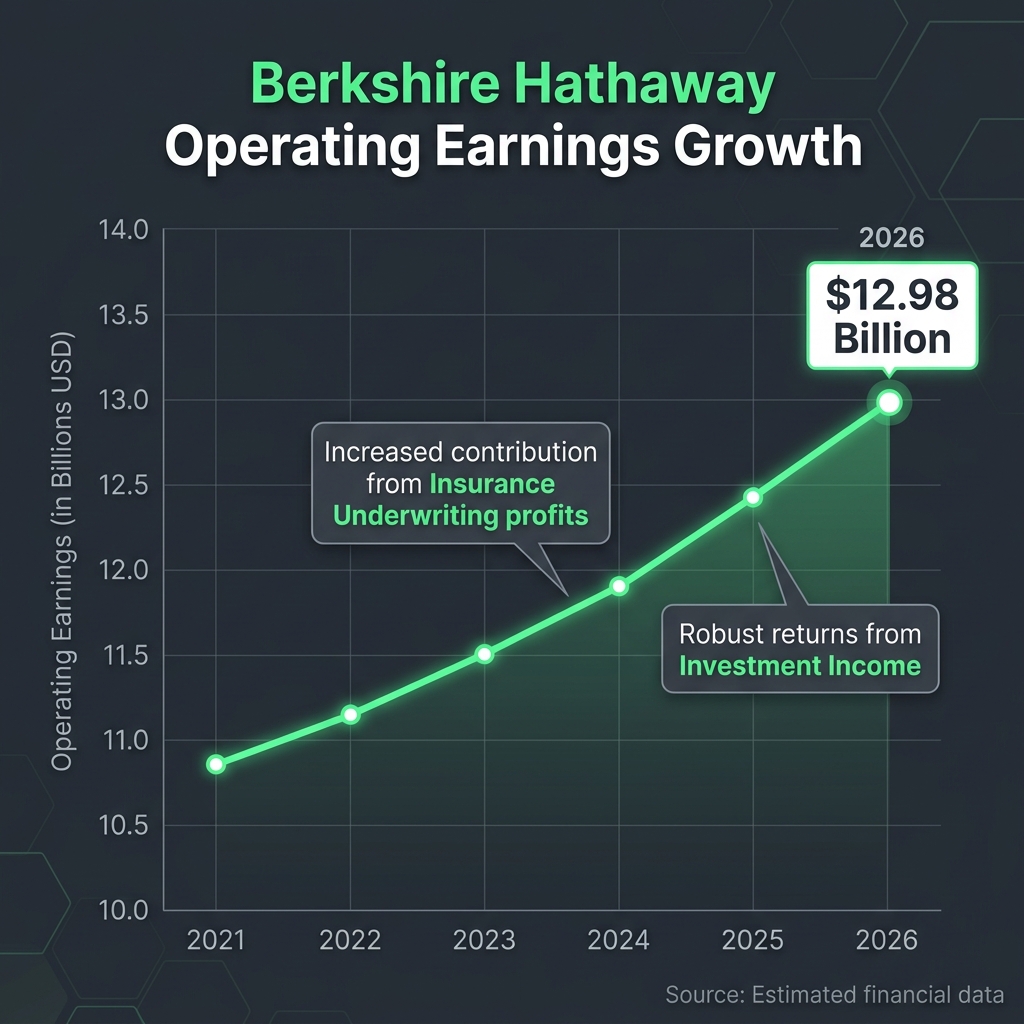
Additionally, GEICO’s comprehensive structural turnaround contributed significantly to overall insurance gains. Improved loss ratios, strategic premium rate adjustments, and reduced claims severity allowed Berkshire’s insurance float to expand to historic highs. Consequently, corporate operating cash flows strengthened dramatically, providing management with unprecedented dry powder despite broader macroeconomic volatility.
2. Ending the 14-Quarter Selling Streak: $10 Billion Alphabet (Google) Investment
Secondly, the primary catalyst driving Berkshire Hathaway 2026 trending momentum was the dramatic pivot in equity deployment. After 14 consecutive quarters as a net seller of stocks, Berkshire deployed nearly $20 billion into public equities, highlighted by a landmark $10 billion stake in Alphabet Inc. (Google). This strategic entry into hyper-scale technology signals CEO Greg Abel and Chairman Warren Buffett’s confidence in enterprise AI infrastructure and dominant digital advertising moats.
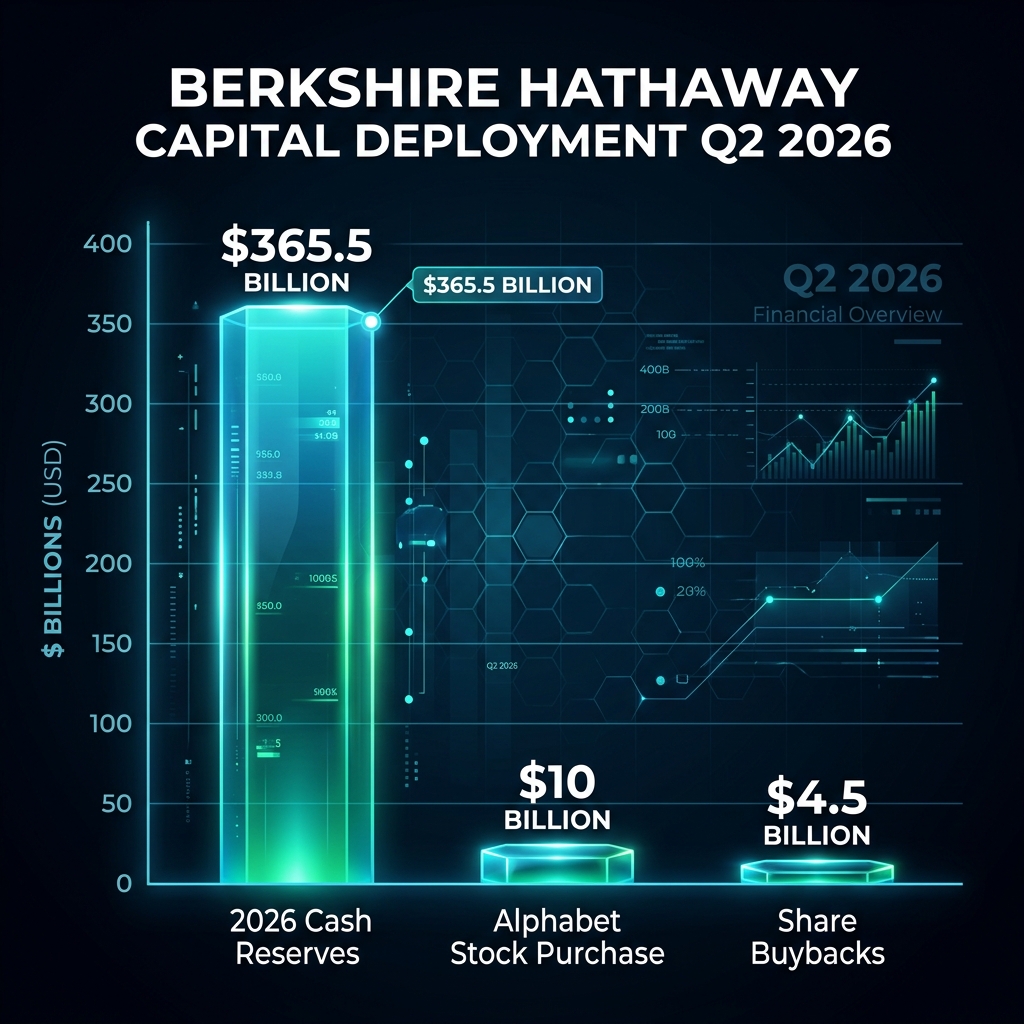
Furthermore, official regulatory filings with the U.S. Securities and Exchange Commission (SEC) confirm that Berkshire Hathaway reduced its cash pile from nearly $400 billion down to $365.5 billion. Simultaneously, the company executed $4.5 billion in aggressive share repurchases during Q2 the largest quarterly stock buyback payout since 2021’demonstrating management’s strong belief that Berkshire’s own equity offered compelling intrinsic value.
3. Managing a $365.5 Billion Fortress Cash Pile vs Equity Sales
Thirdly, examining Berkshire Hathaway 2026 cash management reveals a disciplined balance sheet strategy. While Berkshire trims select legacy bank equity stakes, including Bank of America and Apple trims over prior quarters, the proceeds have been recycled into high-yielding U.S. short-term debt and opportunistic tech leaders. With Treasury bills yielding over 4.5% to 5%, Berkshire earns over $15 billion annually in risk-free interest income while awaiting attractive acquisition opportunities.
4. Why Retail Investors Track Berkshire Hathaway’s Strategic Cash Signals
Fourthly, retail and institutional market participants pay close attention to Berkshire’s moves because Warren Buffett’s capital allocation has historically foreshadowed broader stock market inflection points. When Berkshire builds cash reserves, it indicates that broad equities may be overvalued relative to historical earnings yields. Conversely, when Berkshire initiates multi-billion dollar tech stakes like Alphabet, it signals selective enterprise value opportunities within dominant technology leaders.
5. Executive Leadership Transition Under CEO Greg Abel
Fifthly, understanding Berkshire Hathaway 2026 strategic trajectory requires reviewing the seamless executive transition. With Greg Abel actively leading capital allocation as Chief Executive Officer and Warren Buffett providing strategic counsel as Chairman, the firm is preserving its core value-investing culture while adapting to modern software ecosystems. As global equity markets navigate valuation multiple expansions, Berkshire’s fortress balance sheet provides investors with unmatched downside protection.
Moreover, historically elevated price-to-earnings ratios across mega-cap equities make defensive balance sheets exceptionally attractive for long-term compounding. For broader macroeconomic strategies on navigating inflationary cycles and interest rate shifts, review our in-depth analysis on US Inflation: 3 Recession-Proof Stocks to Buy.
You Might Also Like
Fed Rate Cuts: 3 High-Yield Stocks to Buy Right Now
How To Profit From The S&P 500 In 2026
3 Proven Stocks That Will Skyrocket in 2026
Key Takeaways for Investors
In summary, Berkshire Hathaway 2026 Q2 financial results underscore a monumental capital reallocation cycle. By combining $12.98 billion in operating earnings, a strategic $10 billion investment in Alphabet, and $4.5 billion in share repurchases, Berkshire is actively positioning itself for long-term enterprise growth. Investors seeking structural balance sheet stability can track ongoing SEC 13F filings for quarterly portfolio shifts.
💡 Further Reading for Investors:
Want to master growth stock valuations and competitive moats?
Check out
The Intelligent Investor by Benjamin Graham – https://amzn.to/4huFG8x
One Up On Wall Street by Peter Lynch – https://amzn.to/4huFLJn
The Psychology of Money by Morgan Housel – https://amzn.to/4fWa9d2
Principles for Navigating Big Debt Crises by Ray Dalio – https://amzn.to/4fZGTCl



Pingback: PLTR Stock: 3 Shocking Reasons to Buy Now