
Lyft stock has quietly delivered stunning returns while most investors missed the opportunity. However, the fundamentals reveal a transformation story that could reshape your portfolio. This rideshare platform turned profitable powerhouse shows why contrarian investments often yield the greatest rewards.
The Turnaround That Wall Street Underestimated
Moreover, Lyft’s recent financial performance signals a dramatic shift in business fundamentals. The company achieved record quarterly results in Q2 2025, generating $1.59 billion in revenue with 10.6% year-over-year growth. Additionally, net income surged to $40.3 million, marking a remarkable turnaround from previous losses.
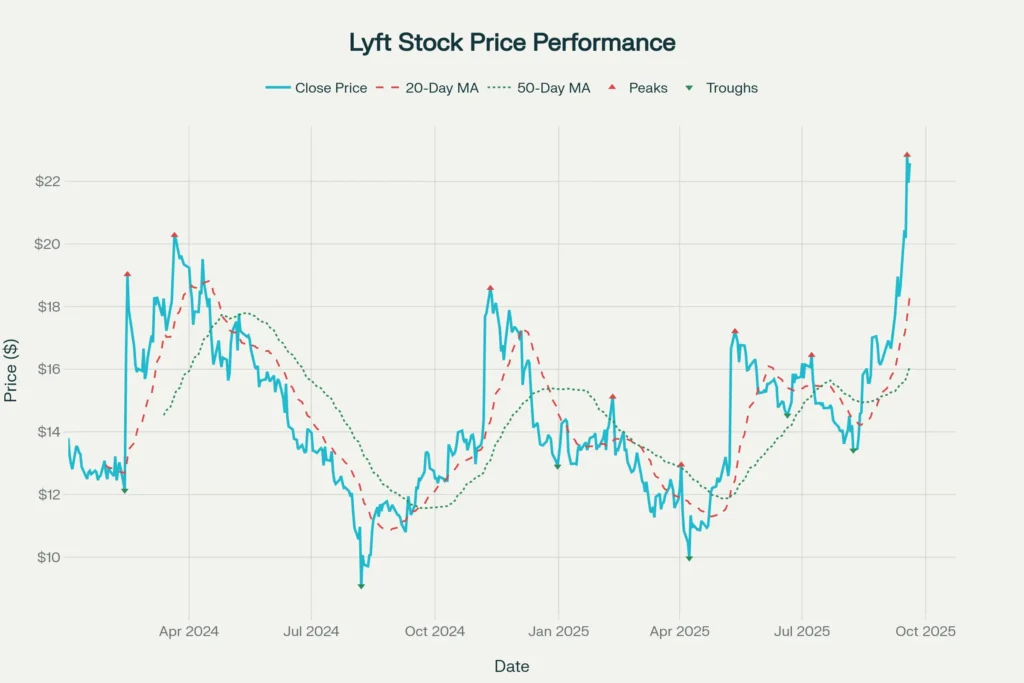
Furthermore, the stock has delivered exceptional returns for patient investors. Lyft shares gained 65.4% year-to-date in 2025, significantly outperforming broader market indices. Similarly, the one-year return reached an impressive 80.2%, demonstrating strong momentum despite market volatility.
Breaking Down the Revenue Engine
Consequently, Lyft’s business model proves increasingly resilient in challenging economic conditions. The platform processed 234.8 million rides in Q2 2025, representing a 14% increase year-over-year. Meanwhile, active riders grew 10% to 26.1 million users, indicating expanding market penetration.

Importantly, gross bookings reached $4.5 billion, up 12% compared to the previous year. This metric shows the total value of rides before Lyft takes its commission. Therefore, higher gross bookings translate directly into revenue growth potential.
Profitability Transformation Accelerates
Nevertheless, the most compelling aspect involves Lyft’s path to sustainable profitability. Adjusted EBITDA hit $129.4 million in Q2 2025, representing a 26% increase from the same period last year. Subsequently, this demonstrates improving operational efficiency across all business segments.
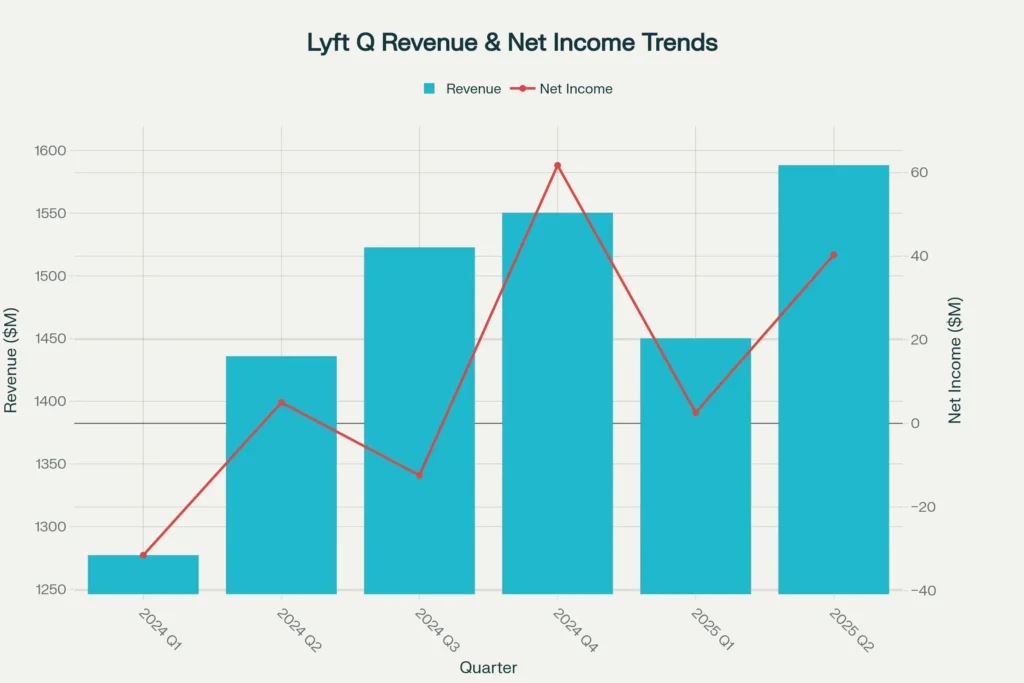
Furthermore, free cash flow reached a record $329.4 million, providing substantial resources for growth investments. Over the trailing twelve months, free cash flow totaled $993 million, offering financial flexibility during uncertain economic periods.
Market Position Analysis: The David Strategy Against Goliath
Nonetheless, Lyft maintains approximately 24-29% market share in the US rideshare industry. While Uber dominates with roughly 70% market share, Lyft’s focused approach yields distinct advantages. Specifically, the company concentrates exclusively on North American markets, allowing deeper regional optimization.
Additionally, Lyft cultivated a reputation for superior driver treatment and community engagement. This differentiation strategy attracts riders who value ethical business practices. Consequently, brand loyalty remains stronger among specific demographic segments.
Geographic Concentration Benefits
Therefore, Lyft’s geographic focus creates operational efficiencies that global competitors cannot match. The company operates in 645 cities across the United States and 10 Canadian cities. This concentrated approach enables:
- Better driver support systems
- Optimized pricing algorithms
- Stronger regulatory relationships
- Enhanced customer service quality
Similarly, this strategy reduces complexity compared to managing global operations across diverse regulatory environments.
Technical Analysis: Chart Patterns Signal Opportunity
Meanwhile, technical indicators suggest potential upside despite recent price appreciation. The stock currently trades at $22.58, near its 52-week high of $23.50. However, the 52-week low of $8.93 demonstrates the dramatic recovery trajectory.

Moreover, analyst consensus indicates further upside potential. The average price target stands at $18.30, though some analysts project targets as high as $28.00. This represents potential gains even from current elevated levels.
Key Support and Resistance Levels
Subsequently, key technical levels include:
- Support: $20.00 (psychological level)
- Resistance: $24.00 (previous highs)
- Breakout target: $28.00 (analyst high target)
Additionally, trading volume patterns suggest sustained institutional interest rather than speculative buying.
Competitive Advantages That Create Long-Term Value
Furthermore, Lyft developed several competitive moats that protect market position:
Driver Preference: Dual-app drivers report 23 percentage point preference for Lyft platform. This indicates superior driver experience and potentially better service quality.
Innovation Focus: The company launched Lyft Silver, targeting older adult demographics. This expansion into underserved markets creates new growth opportunities.
Strategic Partnerships: Recent collaborations with United Airlines and Baidu demonstrate expansion beyond traditional rideshare services.
Financial Health Indicators
Therefore, key financial metrics reveal a company transitioning from growth-at-all-costs to profitable expansion:
- P/E Ratio: 98.17 (high but justified by growth trajectory)
- Market Cap: $9.18 billion
- Revenue Growth: 10.6% year-over-year
- Margin Expansion: Improving across all segments
Risk Factors Every Investor Must Consider
However, several risks could impact future performance:
Economic Sensitivity: Rideshare demand correlates strongly with economic conditions. Recession risks could reduce ride frequency and pricing power.
Regulatory Challenges: Driver classification laws and minimum wage requirements create ongoing compliance costs.
Competition Intensity: Uber’s larger scale provides advantages in driver acquisition and pricing flexibility.
Valuation Concerns
Nevertheless, current valuation metrics suggest limited margin of safety. The P/E ratio of 98.17 indicates high expectations built into the stock price. Therefore, any disappointing quarterly results could trigger significant corrections.
Future Catalysts That Could Drive Stock Performance
Meanwhile, several upcoming developments could accelerate growth:
Autonomous Vehicle Integration: Partnerships with technology companies position Lyft for the autonomous driving transition.
International Expansion: The FreeNow acquisition provides European market access, expanding total addressable market.
Service Diversification: Beyond rideshare, Lyft explores delivery, logistics, and multi-modal transportation solutions.
Financial Projections and Targets
Consequently, management guidance suggests continued momentum:
- Q3 2025 gross bookings: $4.65-4.80 billion
- Adjusted EBITDA: $125-145 million
- Rides growth: Mid-teens percentage year-over-year
Investment Thesis: Why Patient Capital Wins
Therefore, Lyft represents a turnaround story with compelling fundamentals. The combination of improving profitability, market share stability, and strategic positioning creates attractive risk-adjusted returns potential.
Similarly, contrarian investors who recognized the transformation early have been rewarded. However, the journey toward sustainable competitive advantages continues developing.
Portfolio Allocation Considerations
Furthermore, appropriate position sizing depends on individual risk tolerance. Growth-oriented investors might consider larger allocations, while conservative investors should limit exposure given valuation concerns.
Ultimately, successful investing requires patience and discipline. Lyft’s transformation from loss-making startup to profitable platform demonstrates why fundamental analysis matters more than short-term price movements.
This is purely educational analysis and does not constitute investment advice. Stock markets are subject to risk and volatility. Always conduct your own due diligence before making any investment decisions. We do not encourage users to buy, sell, or hold any securities.
You Might also find this post insightful – https://bosslevelfinance.com/can-uber-keep-surging-the-real-story
💡 Further Reading for Investors:
Want to master growth stock valuations and competitive moats?
Check out
The Intelligent Investor by Benjamin Graham – https://amzn.to/4huFG8x
One Up On Wall Street by Peter Lynch – https://amzn.to/4huFLJn
The Psychology of Money by Morgan Housel – https://amzn.to/4fWa9d2
Principles for Navigating Big Debt Crises by Ray Dalio – https://amzn.to/4fZGTCl
Sources:
- Lyft Quarterly Earnings Reports Q1-Q2 2025
- SEC Filings and Financial Statements
- Analyst Reports from Morgan Stanley, BMO Capital Markets, Wells Fargo
- Market Share Data from Statista and Second Measure
- Stock Price Data from Financial Markets
- Industry Analysis from Various Financial Publications
- https://www.just-auto.com/news/lyft-q2-2025/
- https://www.ainvest.com/news/lyft-q2-2025-earnings-estimates-sets-records-rides-revenue-free-cash-flow-2508/
- https://www.ainvest.com/news/lyft-2025-recovery-growth-strategic-momentum-institutional-confidence-drive-optimism-2509/
- https://finance.yahoo.com/news/lyft-stock-declines-0-7-133800487.html
- https://www.quiverquant.com/news/Lyft+Reports+Record+Q2+Results+with+$1.6B+Revenue,+Closes+Freenow+Acquisition
- https://stockanalysis.com/stocks/lyft/revenue/
- https://www.sec.gov/Archives/edgar/data/1759509/000175950925000084/lyft-20250331xpressrelease.htm
- https://finance.yahoo.com/news/lyft-reports-record-q2-2025-200200968.html
- https://simplywall.st/stocks/us/transportation/nasdaq-lyft/lyft/news/is-lyfts-45-rally-in-2025-justified-after-latest-earnings-su
- https://investor.lyft.com/news-and-events/news/news-details/2025/Lyft-Reports-Strong-Q1-2025-Financial-Results/default.aspx
- https://www.nasdaq.com/articles/lyft-lyft-q2-rides-jump-14-record
- https://www.directorstalkinterviews.com/lyft-inc-lyft-stock-analysis-riding-high-with-a-10-60-revenue-growth-in-the-tech-sector/4121216046
- https://www.marketbeat.com/stocks/NASDAQ/LYFT/earnings/
- https://investor.lyft.com/news-and-events/news/default.aspx
- https://companiesmarketcap.com/inr/lyft/revenue/
- https://investor.lyft.com/news-and-events/news/news-details/2025/Lyft-Reports-Record-Q2-2025-Financial-Results/default.aspx
- https://www.stockinsights.ai/us/LYFT/earnings-transcript/fy25-q2-ba62
- https://www.linkedin.com/news/story/lyft-lags-uber-on-revenue-growth-6497108/
- https://investor.lyft.com/overview/default.aspx
- https://www.nasdaq.com/market-activity/stocks/lyft/earnings
- https://canvasbusinessmodel.com/blogs/competitors/lyft-competitive-landscape
- https://www.directorstalkinterviews.com/lyft-inc-lyft-stock-analysis-eyeing-a-24-upside-with-strategic-growth-in-ridesharing/4121210154
- https://www.statista.com/statistics/910704/market-share-of-rideshare-companies-united-states/
- https://www.nasdaq.com/articles/why-lyft-stock-could-go-overdrive-2025
- https://secondmeasure.com/datapoints/rideshare-industry-overview/
- https://www.marketbeat.com/stocks/NASDAQ/LYFT/forecast/
- https://www.aabri.com/manuscripts/203321.pdf
- https://in.tradingview.com/symbols/NASDAQ-LYFT/forecast/
- https://www.gbis.ch/index.php/gbis/article/download/111/75
- https://bvwd.ca.gov/market-outlook/Can-LYFT-stock-sustain-revenue-growth
- https://drivemond.app/blog/ride-sharing-market-analysis/
- https://www.cnn.com/markets/stocks/LYFT
- https://seekingalpha.com/article/4814426-lyft-quality-name-that-offers-margin-of-safety-trading-at-a-reasonable-price
- https://intellectia.ai/stock/LYFT/forecast
- https://freedom24.com/ideas/details/16686
- https://finance.yahoo.com/quote/LYFT/
- https://www.dbs.com.sg/treasures/aics/templatedata/article/generic/data/en/GR/US/LYFT_US.xml
- https://www.gminsights.com/industry-analysis/us-ride-sharing-market